
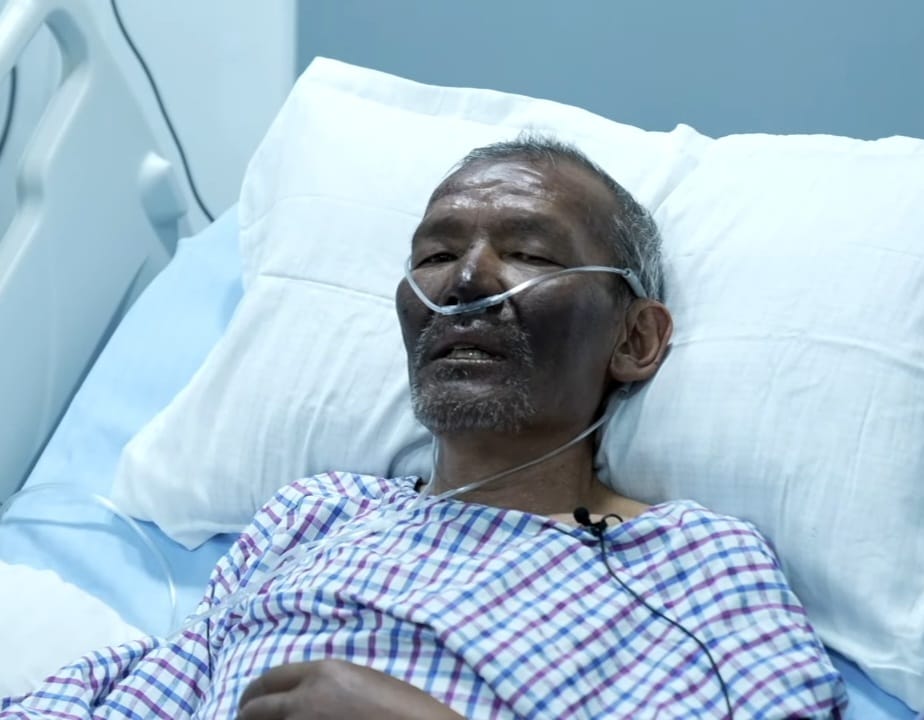

On the morning of June 4, 2026, workers from the Sagarmatha Pollution Control Committee were doing routine cleanup near the Khumbu Icefall when they spotted something unusual at Crampon Point, just below the icefall and not far from Everest Base Camp.
It was a man. Crawling.
His hands were frostbitten. His feet were frostbitten. He was severely weakened. But he was alive.
The man was Dawa Sherpa, 52, a mountaineering worker from Okhaldhunga known to friends and colleagues by his nickname “Hillary.” He had been missing on the mountain for seven days.
Dawa was working for a small Nepali outfitter called Himalayan Traverse Adventures. His job, notably, was not to guide climbers to the summit. He had been hired as the cook at Camp 2, at around 21,000 feet. Somehow, he ended up escorting a Polish client —later identified as Mariusz Chmielewski during a summit push toward the top of the world.
On May 28, Dawa helped his client reach the summit of Everest. On the descent, things began to fall apart. Chmielewski was suffering from severe frostbite, particularly on his hands. The group which also included British climber Chris Thrall and at least one other Sherpa began making their way down. Somewhere near the Yellow Band, just above Camp 3 at around 7,500 meters, the group got separated.
The client and others continued descending. Dawa stayed behind.
That was the last time anyone saw him for a week.
In an interview with BBC Nepali journalist Kamal Pariyar, Dawa described what those six days alone on Everest felt like.
“I didn’t think I would survive. I thought I was finished,” he said.
He explained that he had not been lost he had simply run out of oxygen. “My oxygen ran out and I couldn’t walk. After the oxygen finished, I was confused and couldn’t move for two days.”
For two days he ate nothing. Then he started eating snow. “Chewing the ice made my teeth hurt,” he said. He also had some chocolate with him, which he survived on.
He grabbed fixed ropes and pulled himself along. He walked through the night and through the day. At one point, an avalanche had struck the route ahead of him. He kept going anyway.
This is where the story turns uncomfortable.
May 29 the day Dawa went missing was among the last days of the climbing season. The Khumbu Icefall route was already being dismantled. Ladders were being pulled. Teams were packing up and heading home.
His employer, Himalayan Traverse Adventures, did not launch an immediate rescue. No ground team went back up. According to reports, the managing director initially confirmed that Dawa had been left alone on the mountain, but no organized search was sent before the route closed.
A helicopter search was eventually organized not by his own company, but by 8K Expeditions, a separate Nepali mountaineering firm, coordinating with the family’s request. That search, conducted days later, initially found nothing.
Back in Kathmandu, Dawa’s wife Damu had begun funeral rituals. His family was lighting lamps for a man who was, at that very moment, dragging himself across crevasses.
The Polish client Chmielewski, who had safely descended, later accused the expedition company of negligence and mismanagement. Nepali officials described the situation as abandonment and a delayed rescue. The company has faced widespread criticism.
It would be unfair to tell this story without acknowledging what the others on that descent were facing.
Mariusz Chmielewski, the Polish client Dawa had guided to the summit, was not a man in good condition when the group separated. His hands were severely frostbitten. He was struggling to move. By the time the group reached the area near the Yellow Band, he needed help himself. Chris Thrall, the British climber in the group, linked up with Chmielewski and helped bring him down to the lower camps. That decision to keep moving with the person in front of them is the kind of decision people make when they are exhausted, oxygen-depleted, and trying to survive at 7,500
Chmielewski has since spoken out. He did not stay silent about what happened. He accused the expedition company of negligence and mismanagement which suggests that he too believes the failure was institutional, not personal. He did not claim the mountain was well-managed. He pointed at the same system many others are now pointing at.
These are not villains. These are human beings who were in a brutal place making decisions in real time. The mountain does not give you minutes to hold a meeting.
But here is what the mountain also does not excuse the silence that followed at Base Camp. The packed bags. The pulled ladders. The days that passed before anyone with authority and resources made a serious, sustained effort to find a man who was still up there.
The climbers came down. That is understandable. What is harder to understand is what the expedition company and the broader mountaineering system did, or did not do, in the days that followed.
Men like Dawa hold the mountain together. They fix the ropes that everyone else clips into. They carry the oxygen that keeps clients alive. They cook the meals, manage the camps, and make the decisions that bring people home. And when one of them goes missing, the system that profits from their labor should not be the last to respond. It should be the first.
Dawa’s wife asked a question from the hospital that many in Nepal’s mountaineering community are now repeating what would the response have been if a foreign paying client had gone missing in the same place?
The question does not need much imagination to answer. If a foreign tourist had gone missing above Camp 3, satellite phones would have been active within hours, helicopters in the air at first light, embassies and insurance companies and international media all moving at once.
Dawa a 52-year-old man who had spent his life making Everest possible for others got a delayed helicopter on day five or six.
Nepal collected record permit fees this season, with over 1,000 summit attempts. Damu asked publicly why, with all that revenue flowing through Everest, nobody answered her calls for help.
Dawa was airlifted to a hospital in Kathmandu on June 4. His daughter, upon seeing footage of the rescue, asked for a photo just to confirm the man being carried off the helicopter was really her father.
He survived six days in the death zone without food, without water, and without supplemental oxygen. He descended thousands of meters largely on his own through avalanche-struck terrain, across ladderless crevasses, and past a helicopter that looked right through him.
The world called it a miracle.
But Dawa’s family is calling it something else. They are calling it a failure by a company, by a system, and by an industry that has long relied on men like Dawa to carry everyone else to the top, and has not always been in a hurry to carry them back down.
At this platform, we tell stories of mountains all of them, from every angle. That means we tell the climbers’ side. We tell the companies’ side. We tell the side of the families waiting at home. And we tell the side of the men and women who make this industry possible but rarely make the headlines unless something goes wrong.
Dawa’s story is not one we will simply file away. We will keep asking questions about accountability, about the value placed on local workers’ lives, about what “rescue” really means when the season is ending and the ladders are coming down. We asked those questions this season. We will ask them next season. We will keep asking until the answers change, because if we stop asking, the system has every reason to stay exactly as it is.
Sources: Outside magazine, BBC Nepali, Explorers Web, Kathmandu Post, and other officials comment on social media.
