

They left a coffee tin on the summit.
It was the only monument they had time to build. Someone had carried it up through three camps and a night of rock climbing in the dark, and now, on the Central Summit a separate, harder point on the mountain that no one had ever reached before them they unscrewed the lid and wrote their names on scraps of paper and folded them inside and set it down among the rocks.
It was 7:30 in the evening on July 28, 1975. The wind was already rising. They did not know it yet, but they had about eighteen hours to live as a group of five.
Eighteen years earlier, an Austrian team had put four men on Broad Peak’s main summit without a single death. Marcus Schmuck, Fritz Wintersteller, Kurt Diemberger and Hermann Buhl had climbed it clean, no oxygen, no fixed ropes, no high-altitude porters, and walked away.
In the years since, no one had died on the mountain at all. Broad Peak, at 8,051 meters in Pakistan’s Karakoram, had a strange reputation among the fourteen 8,000-meter giants: hard, but not yet a killer.
That changed on the way down from the tin.
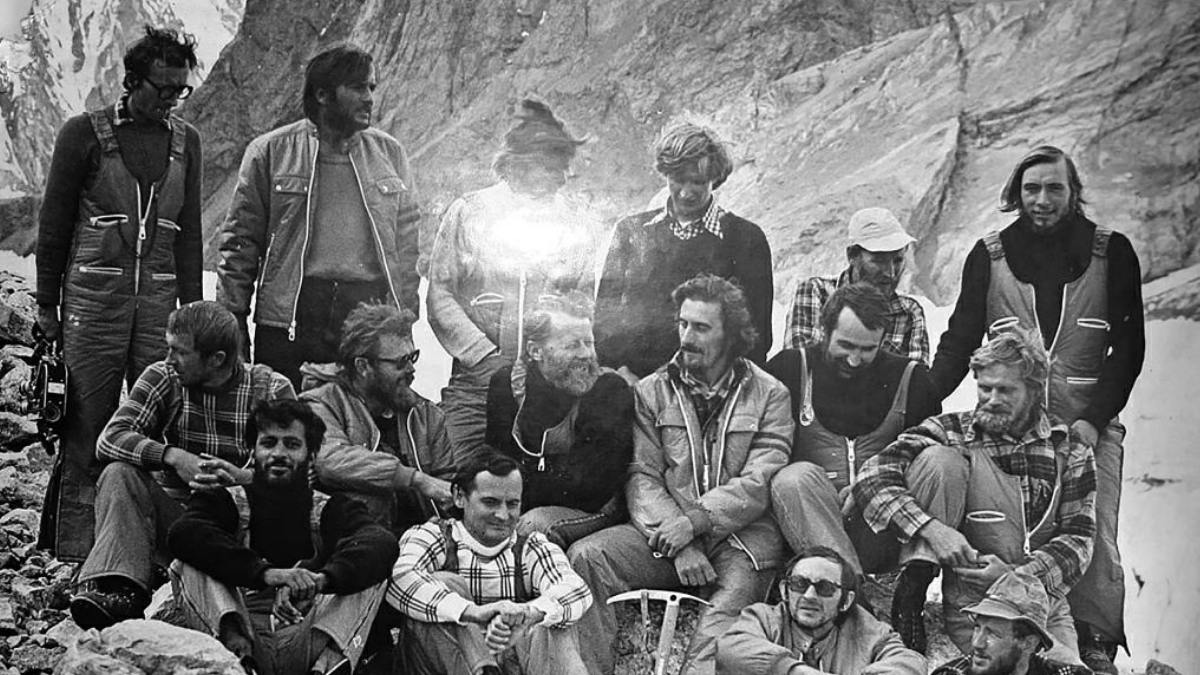
Five men reached the Central Summit that evening Kazimierz Głazek, Janusz Kuliś, Bohdan Nowaczyk, Marek Kęsicki and Andrzej Sikorski, members of a fifteen-strong Polish expedition out of the High Mountaineering Club in Wrocław, led by Janusz Fereński.
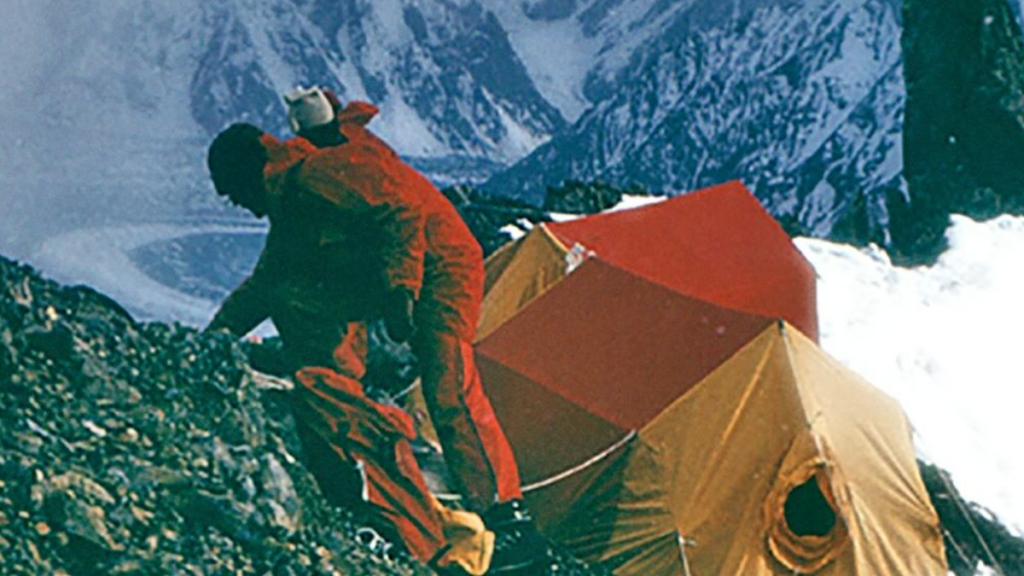
They had fought for the top later than they wanted, working through rock sections that ate the afternoon, and by the time they stood at roughly 8,011 to 8,016 meters, the light was already going. They told themselves the storm gathering over the ridge might pass.
They talked about coming back up for photographs once it cleared. Then they turned and started down, hoping to outrun the weather to a snow terrace below.
They had just made the first Polish ascent of an 8,000-meter peak. They had a few hours left before it started costing them everything.
The descent went wrong almost immediately. Roping down toward the col in the dark, with the wind climbing and the temperature falling toward minus 35 degrees Celsius, Bohdan Nowaczyk last man on the rope went over the edge. Whether the rappel anchor gave way or a gust simply took him, no one can say for certain.
What is certain is the direction: down the Chinese side of the ridge, into rock-and-ice walls that drop nearly three kilometers. Głazek would later write it as plainly as anyone can write such a thing: with horror we realize that Bohdan has fallen together with the rope into the precipices of the Chinese side of the massif, where the rock-and-ice walls are about three kilometers high. Calls and shining headlamps have no effect.
That was the sentence that ended it calls and shining headlamps have no effect. Four men standing on a ridge in a gathering storm, screaming a name into three kilometers of black air, and nothing coming back.
They had also just lost their only rope.
What followed was not a retreat. It was a night with nowhere to go. Głazek, Kuliś, Kęsicki and Sikorski were now unroped on hard, icy ground above 7,700 meters, in the middle of a storm, with no rope to protect a fall and no way down before dark closed in completely. They stopped where they stood and tried to make the mountain give them something – anything- to get through the night. There were no tents. There were no sleeping bags.
They scraped at the snow with bare, half-frozen hands to dig a shallow hole, something less a shelter than a place to not quite be in the open wind. Głazek was so depleted by cold and thin air that he forgot, for hours, that he had a bivouac sheet folded in his own pocket a piece of fabric that might have made the difference between frostbite and worse, sitting against his body the whole time, simply unreachable to a mind that oxygen starvation had emptied out.
They survived that first bivouac. Morning came, and with it, the mountain took two more of them.
Descending on July 29, on hard ice and old crusted snow, Marek Kęsicki and Andrzej Sikorski fell separately, at different points on the slope, hours or minutes apart accounts don’t agree on exactly how far apart, only that both went down and did not get up.
Głazek and Kuliś found Sikorski first: on his back, head low in the snow, a wound at his temple, no breath, no pulse. And here is the part that says more about them than any summit photograph could his face was not yet fully rigid, and so they did not simply confirm he was gone and move on.
They knelt over him on a mountain that had already taken one friend into a three-kilometer drop, and they performed mouth-to-mouth resuscitation. They did external heart massage. They kept going long after the outcome was already decided, because as long as his face hadn’t set, there was a window, however small, where hope was still technically allowed. It closed anyway. Kęsicki’s body was never found.
Two men were left of the five who had signed their names and left them in a tin can the evening before.
Głazek and Kuliś still had to get down. They endured two more open bivouacs Głazek later called them nightmarish at around 7,700 to 7,800 meters, with no tents, no bags, and frostbite already setting into their hands and feet. Piece by piece, camp by camp, with teammates coming up to help pull them the last distance, they made it to lower ground and then to Base Camp, arriving on the night of August 1 into August 2 four days after they’d stood on top.
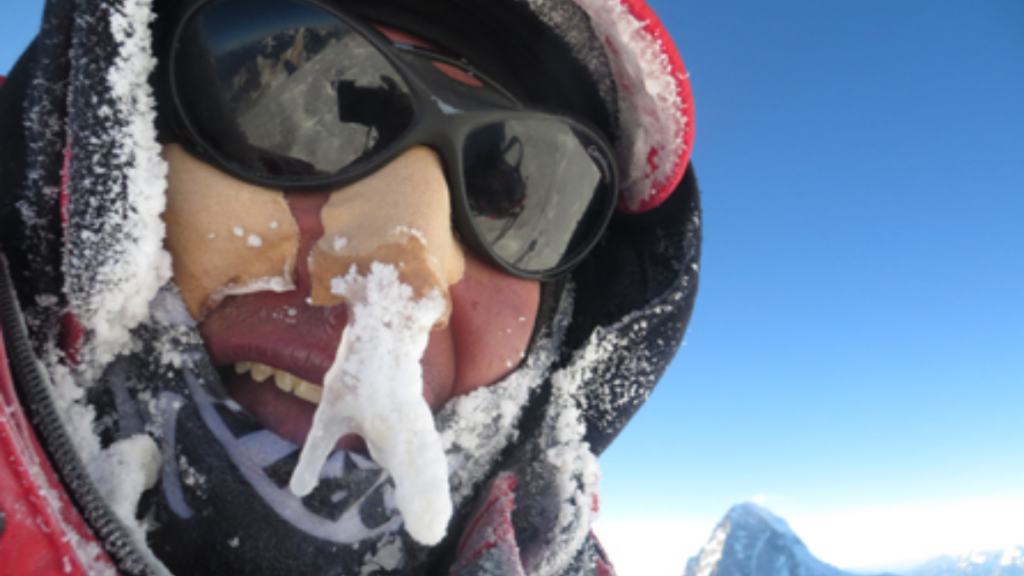
Głazek had frostbite to his hands and legs. Kuliś’s feet were worse; the damage was severe enough that he would later lose several toes to amputation. The expedition evacuated Base Camp on August 5 and reached Skardu eleven days after the summit.
In the official reporting that followed, and in Głazek’s own detailed account published in the Polish climbing journal Taternik and later carried in English under titles like “Victory and Tragedy on Broad Peak” no one tried to pin the deaths on a single mistake.
The verdict, in Głazek’s own words, was this
The deaths of our friends happened due to the exceptionally unhappy coincidence of events, but first of all to the sudden, totally unforeseen break in the weather, which left us helpless on the face.
It reads like an engineer’s report, because Głazek more or less was one he’d go on climbing, including attempts on K2, before he died in 2005, having written the most complete technical record anyone has of those forty hours.
Janusz Kuliś, the last of the five still alive by the time journalists came around for the fortieth and forty-fifth anniversaries, told the story differently. He didn’t reconstruct angles of fall or wind speeds. He simply refused, every time, to let anyone call what happened up there a success.
Three companions had died coming down from a summit no Pole had ever stood on before them, and to Kuliś that fact settles the question before anyone can ask it. It was not a victory. It was a tragedy that happened to pass through a summit on its way to becoming one.
That is, in the end, the whole shape of what happened on Broad Peak in the last week of July 1975. A team of Polish climbers did something no one from their country had ever done at 8,000 meters. They wrote their names on paper and sealed them in a coffee tin on the one summit of Broad Peak that had never felt a boot before theirs.
And within a day, the mountain had taken three of the five who put them there one into a three-kilometer void on the Chinese side, two on the ice below, one of them worked over by his own friends’ hands long after it was too late, because they weren’t ready to stop trying.
For fifty years since, Broad Peak has carried that beginning into everything that came after it every fall on the ridge, every avalanche lower down, every season that has tested climbers against its exposed upper mountain.
It started here, with five names in a tin can, and two men walking back into Base Camp with frostbitten hands, refusing, then and for the rest of their lives, to call it anything other than what it was.
