
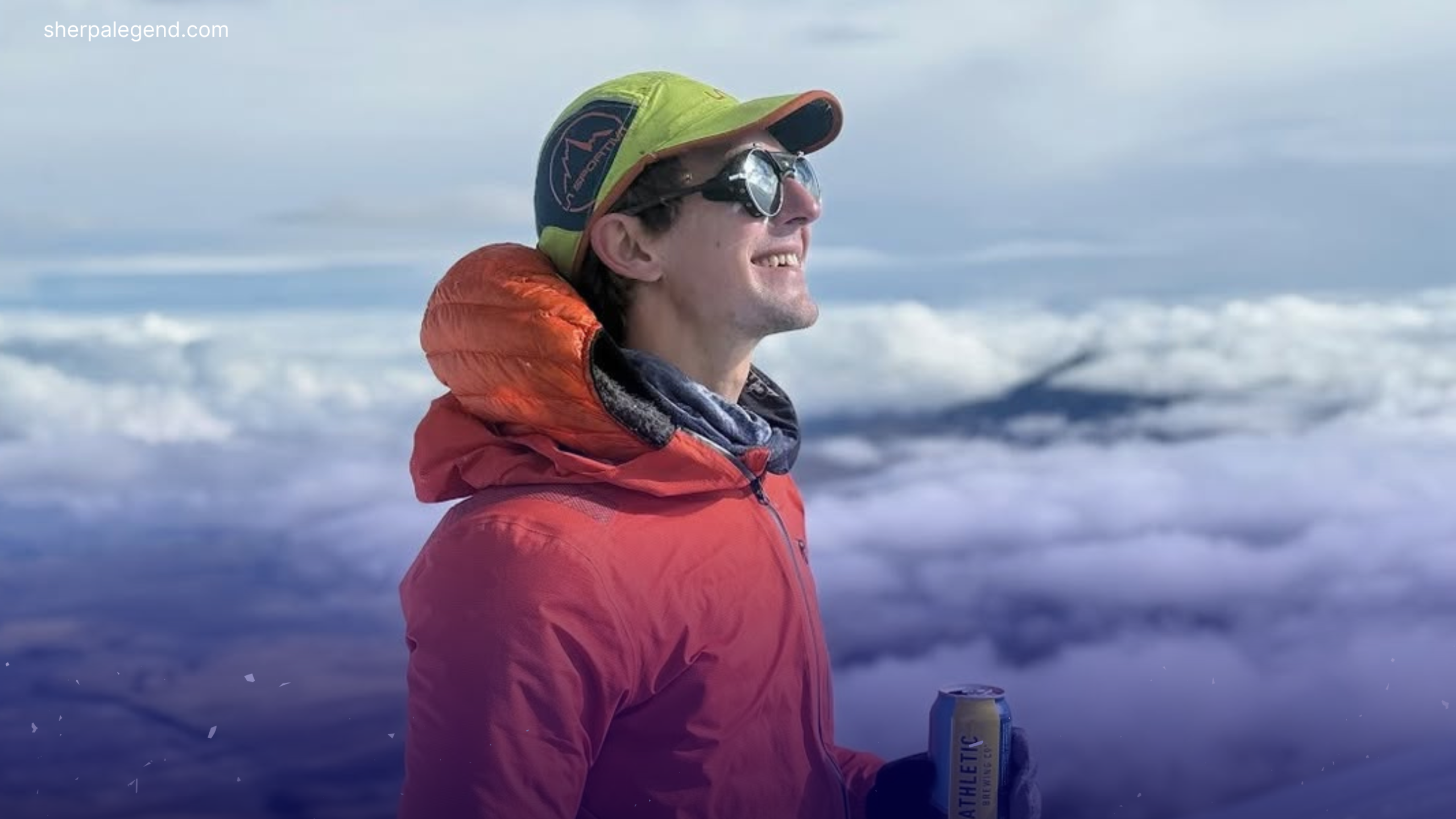

Tyler Andrews, Who Brings Ultra-Running to the Himalayan Giants
Tyler Andrews began his journey as an American athlete from Massachusetts, building his reputation in the running world before making a significant shift to mountain and trail running around 2019.
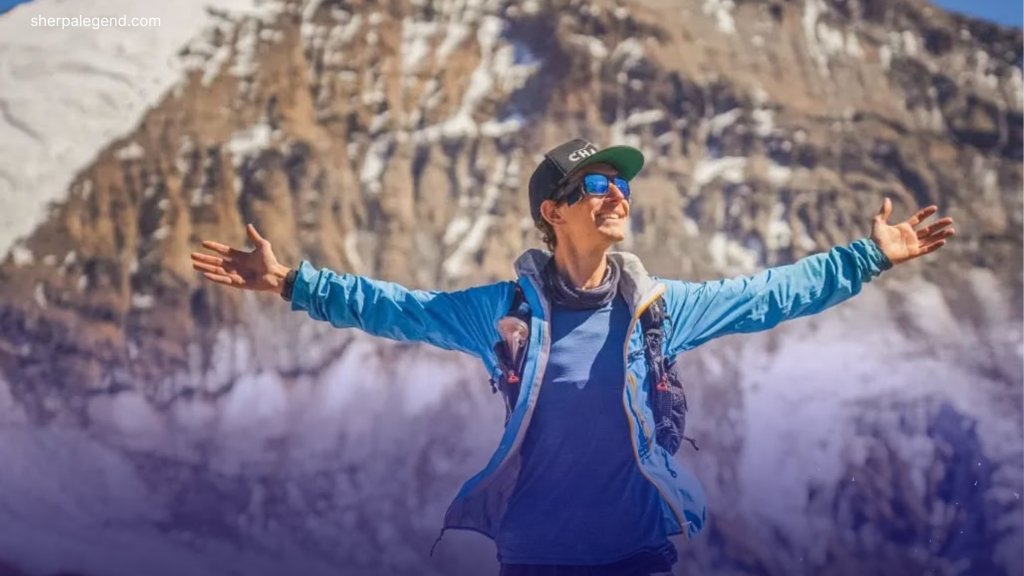
His passion for high-altitude challenges led him to split his time between Flagstaff, Arizona, and Quito, Ecuador locations that allowed him to train at elevations that would prepare him for the world’s greatest mountains.
Early Mountain Success
Andrews first grabbed headlines in the mountain running community in 2019 when he set a world record on Peru’s Salkantay Inca Trail, completing the challenging 60km route in just 6 hours, 13 minutes, and 2 seconds.
That same year, he won the USATF 50 Mile National Championship, setting a course record that demonstrated his extraordinary endurance.
During the COVID-19 pandemic, when many athletes struggled to find competitions, Andrews turned to creative challenges. He set a world record for running 50km on a treadmill and completed the Everest Base Camp Trail round trip in under 24 hours early signs of his attraction to high-altitude feats.
The Transition to Mountain Speed Records
From 2021 onward, Andrews found his true calling in setting speed records on some of the world’s most iconic mountains. His approach was distinctive minimalist gear, complete self-sufficiency, and often climbing without supplemental oxygen.
This style drew comparisons to legendary alpinist Reinhold Messner, known for his purist approach to mountaineering.
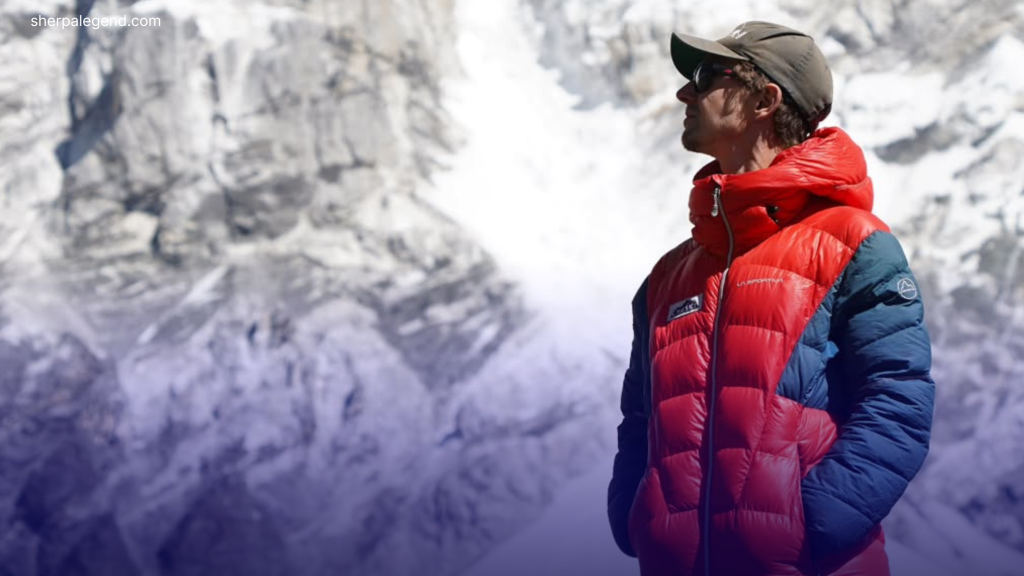
Andrews began establishing himself as an elite mountain athlete with impressive achievements on peaks around the world
In 2021, he set the Fastest Known Time (FKT) on Cotopaxi in just 1 hour, 36 minutes, and 35 seconds
That same year, Ojos del Salado—the highest volcano on earth—in 9 hours, 29 minutes, and 46 seconds
In 2022, he completed a sea-to-summit-to-sea record on Mount Fuji in 9 hours, 50 minutes, and 38 seconds
2023 saw him break records on Kilimanjaro, surpassing the time set by running legend Kilian Jornet
Also in 2023, he set an FKT on Aconcagua with a summit push of 11 hours, 24 minutes, and 46 seconds
The Himalayan Challenge: Manaslu
Perhaps Andrews’ most significant achievement came in September 2024 on Manaslu, the world’s eighth-highest mountain standing at 26,781 feet. Known as the “Mountain of the Spirit,” Manaslu represents a significant step up in challenge from his previous conquests.
What made this accomplishment particularly meaningful was that it came after failure. Andrews had attempted the same record a year earlier but came up short.
As he explained: “I tried and failed a year ago. And the way that the big mountains go is you often only get one shot a year. And that kind of sucks, but it definitely makes it more special when things go really well.”
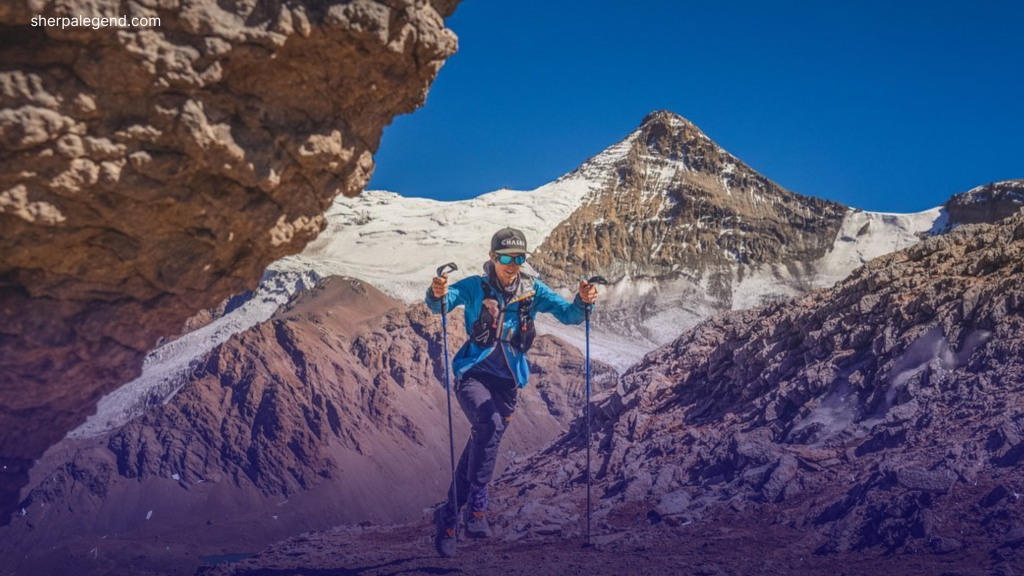
On his successful attempt, Andrews reached the summit from base camp in just 9 hours and 52 minutes without using supplemental oxygen—breaking the previous record by over two hours. He completed the round trip back to base camp in a total of 14 hours and 52 minutes.
Andrews approached the challenge differently than most mountaineers. Rather than viewing it primarily as a technical climbing challenge, he saw it as an endurance test: “I’m approaching this as a runner. And so the routes that are most exciting to me are the ones where fitness is a big percentage… 90% of the route is walking uphill.”
Unique Training Methods
Andrews’ training philosophy is as unconventional as his achievements. For his Manaslu attempt, he actually brought a stationary bike to Base Camp at 4,900 meters above sea level—a decision that shocked many traditional mountaineers. Each day, he would climb 1,000 meters up to Camp 1, return to Base Camp for lunch, and then spend hours on the stationary bike in the afternoon.
“No one knows what they’re doing, including me,” Andrews admitted about high-altitude training. “It was an experiment, and it seemed to work pretty well.”
His approach combines the mentality of an ultra-runner with mountaineering techniques. He focuses intensely on nutrition, typically aiming to consume 300-400 calories per hour during his summit attempts. On his record-breaking Manaslu climb, however, he faced a significant challenge with hydration, bringing only one liter of water for the entire 10-hour ascent.
Mental Fortitude
Beyond physical preparation, Andrews credits his mental approach for much of his success. At extreme altitudes above 7,500 meters—in what mountaineers call the “Death Zone” where human life cannot be sustained long-term—he describes the challenge as being “all above the shoulders.”
“It’s just the way that manifests for me as a sensation. It’s this really tremendous desire to turn around,” he explains.
To combat this, Andrews breaks the mountain into small, manageable segments
“I’m incredibly good at lying to myself. Self-deception is one of my greatest strengths. So I’ll say, ‘Oh, you know what, I’m going to go 50 more meters, and then I’m just going to turn around and go down.’ And then you say, ‘Cool, okay… Now I’m going to do it again.'”
Expanding His Himalayan Achievements
Following his success on Manaslu, Andrews continued his impressive streak in the Himalayas.
In 2024, he set new records on Ama Dablam, completing the base camp to summit and back in just 6 hours, 20 minutes, and 30 seconds.
He also climbed Mera Peak in 15 hours and 52 minutes.
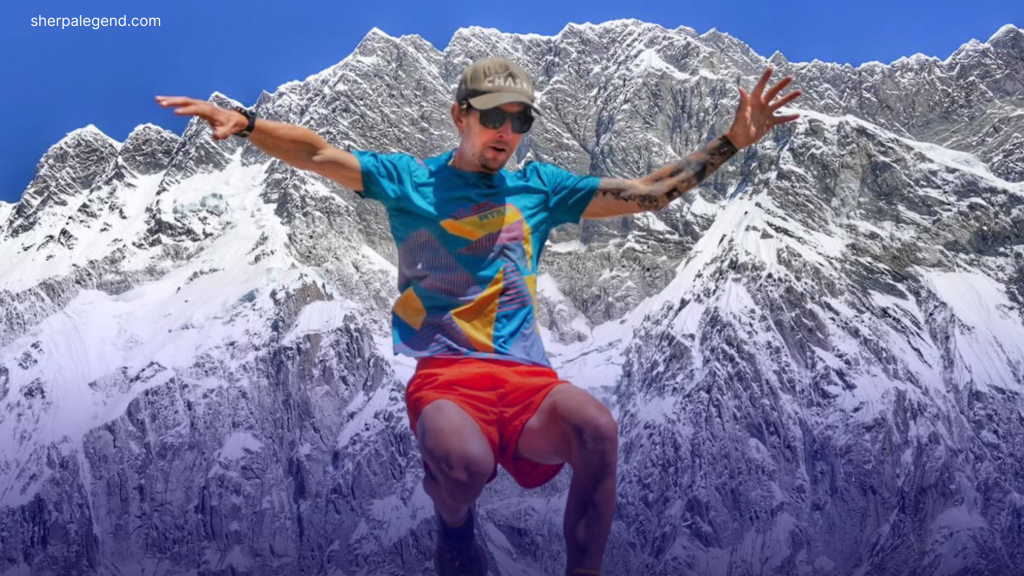
Looking ahead to 2025, Andrews announced plans to attempt an even more ambitious goal—a speed ascent of Mount Everest from the South Side without supplemental oxygen, targeting a time under 20 hours.
This would set a new FKT if successful. His preparation includes multiple ascents of Mera Peak and Baruntse for acclimatization, showing his strategic approach to high-altitude performance.
Minimalist Approach and Safety
Andrews’ minimalist style raises questions about safety, but he argues that his approach actually reduces risk in certain ways: “I think a lot of people have this idea that, ‘Oh, because you’re going in minimal gear, it’s really dangerous.’ I actually think the way that I’m moving the mountain is safer than the average person.”
His reasoning is simple—speed reduces exposure to danger. “I spend so much less time in dangerous places.Whether it’s above 8,000 meters, whether it’s below giant seracs, or on avalanche terrain—I’m able to move so much quicker.”
He points to his experience in the treacherous Khumbu Icefall, which he navigated in just 2 hours compared to the 10 hours it takes some climbers, reducing his exposure to danger by 80%.
A Legacy in the Making
With 69 FKTs to his name, Tyler Andrews has established himself among the elite endurance athletes of his generation, alongside legends like Kilian Jornet and Karl Egloff.
His achievements are redefining the limits of speed and endurance at extreme altitudes, inspiring a new generation of mountain runners and climbers.
Andrews’ journey reflects a philosophy of resilience and innovation. As he says about his early failures “I didn’t just step off the track and onto an 8,000-meter mountain. I got my ass kicked [on my first Manaslu attempt]. But I learned a lot.”
His motivation comes from pushing boundaries and proving skeptics wrong: “When people tell me athletically that something I want to do is not possible, that just gets me really fired up.” This mindset has driven him to achievements few thought possible, combining the speed of an elite runner with the determination of a mountaineer to establish records on some of the world’s most challenging peaks.
As Andrews puts it, his accomplishments represent “a journey, a combination of my love of self-discovery and pushing myself, coupled with this unbelievably competitive inner drive.” With his sights set on Everest and beyond, Tyler Andrews continues to redefine what’s possible in high-altitude endurance sports.
Images used are copyrighted to their respective owners

Very good https://is.gd/N1ikS2