
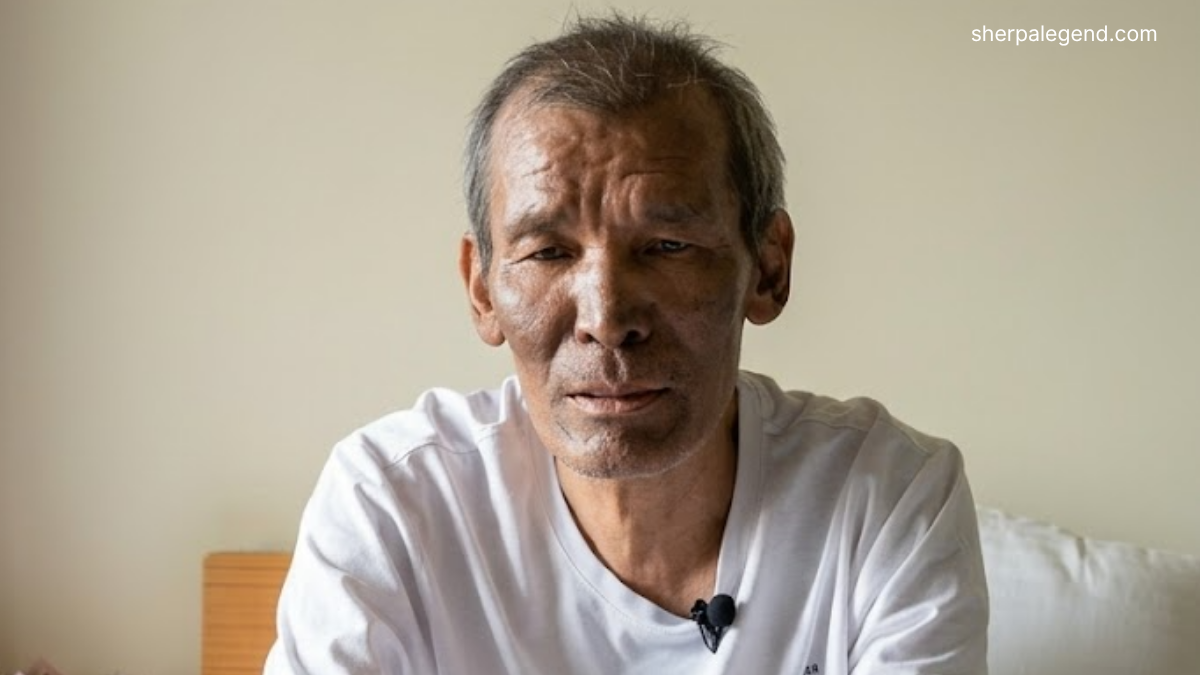

Weeks after a rescue that stunned the mountaineering world, the 57-year-old Sherpa guide is healing in home, thanking strangers for their support, and thinking about the next trek not the next summit.
Dawa Sherpa is getting better.
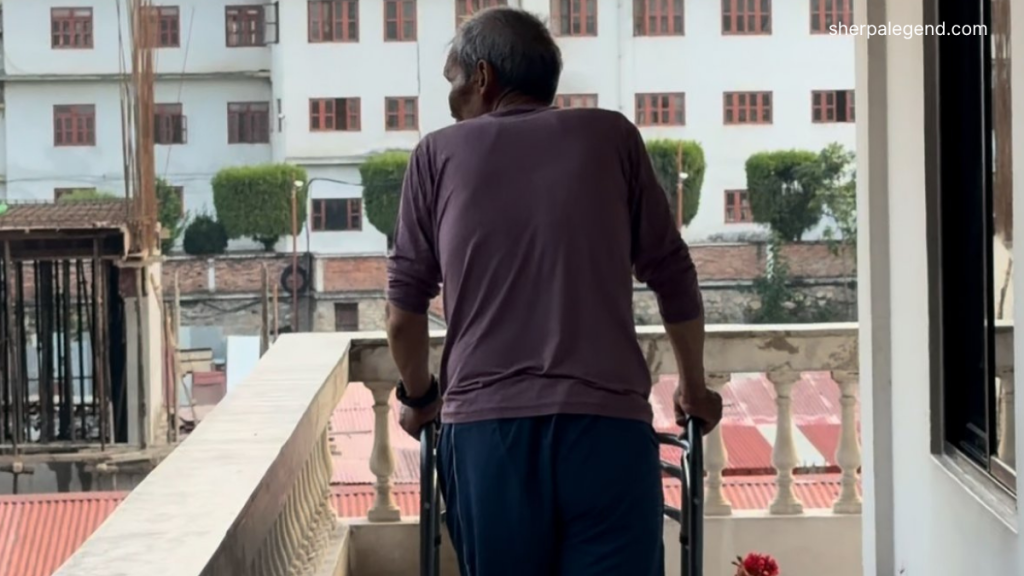
That is the simplest way to say it, and it is also the most important thing his family wants the world to know right now.
Seven days lost above the Khumbu Icefall in May, a rescue that felt impossible, and weeks of hospital care later, the man known to everyone in the mountains as “Hillary Dawa” is no longer fighting for his life. He is fighting to walk normally again, to heal his frostbitten hands and feet, and to figure out what comes next for a man who has spent almost his entire adult life on the slopes of Everest.
His story became one of the defining moments of the 2026 Everest season. Now, weeks later, it is becoming something else too a story about recovery, about a family trying to hold itself together, and about thousands of strangers around the world who decided that a quiet Sherpa cook and load-carrier deserved their help.
The Disappearance That Shocked the Mountain
For readers just catching up Dawa vanished on May 28, 2026, after helping his Polish client reach the summit of Everest. On the descent, his client began suffering from frostbite and was helped down by other climbers, while Dawa stayed behind. He never made it back to base camp. For seven days, there was no signal and no trace of him.
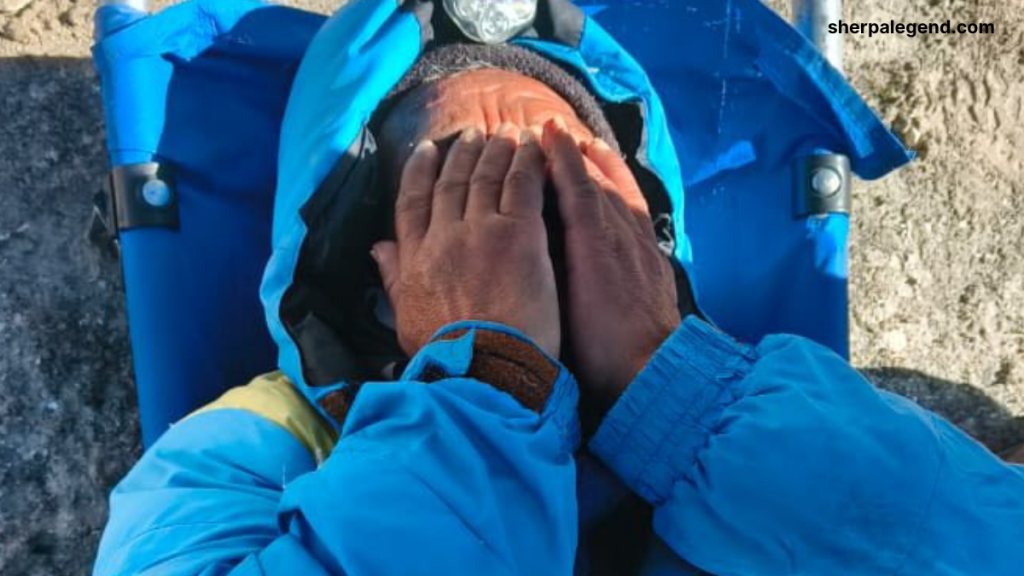
He was finally spotted on the morning of June 4, crawling near the Khumbu Icefall by workers from the Sagarmatha Pollution Control Committee (SPCC).
His hands and feet were frostbitten and he was severely weakened, but he was alive. SPCC’s Executive Director, Tshering Sherpa, confirmed that workers reached him, gave him first aid and food, and stabilized him before a helicopter rescue was arranged.
The story spread quickly, in part because of how it unfolded. Helicopter searches in the days before had turned up nothing above Camp III. It was, in the end, his own determination to keep moving that brought him within reach of rescuers. People in the climbing community had one word for it: miracle.
How He Is Doing Now
Dawa is currently doing his follow up at HAMS Hospital in Kathmandu, where he was airlifted after his rescue. In the first days after he arrived, doctors were seriously concerned that his legs would need to be amputated because of severe frostbite and the effects of extreme cold on his circulation. That fear has now passed. Doctors have determined that amputation will not be necessary and that his legs can be saved.
He still goes back to the hospital for check-ups every three days, and his wounds are not fully healed. According to those treating him, full healing is expected to take several more weeks.
Mentally, those close to him say Dawa is doing well. According to Nurbu Sherpa, his wife’s brother and one of the family members helping coordinate support during this time, Dawa is mentally strong and much like the man he was before the accident. He is eating properly, talking with family members, and welcoming visitors who come to see him. For a man who spent seven days alone at high altitude, convinced at one point that he was going to die, that mental steadiness stands out.
What Happened, In His Own Words
Dawa gave an account of his ordeal in an interview with Everest Live’s Ben Ayers, describing in his own words how he ended up stranded and how he made it back down alive.
He explained that he had gone up the mountain that season as part of a small team, without a fixed climbing partner by his side when things went wrong. After reaching high altitude with a companion who began struggling and eventually stayed behind to rest, Dawa continued alone. His oxygen ran out. His strength gave out. At one point, while trying to cross a section with ladders and fixed ropes near the icefall, he slipped.
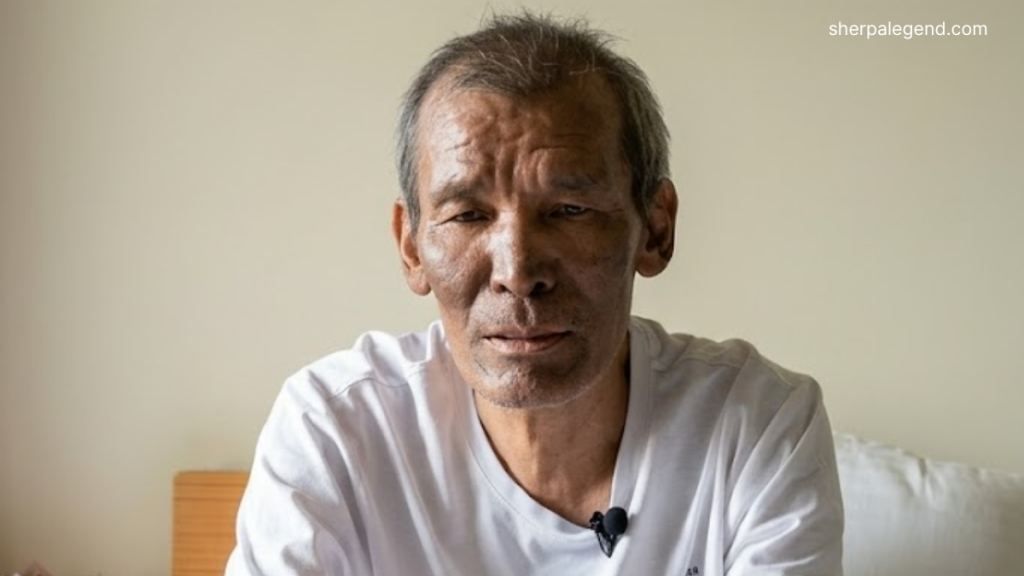
“After that I didn’t feel anything,” he said. He fell head-first down an icy slope and kept sliding until he finally stopped. His first thought, he said, was that this was the day he was going to die. He had hit his head. He believed, in that moment, that his life was over.
What saved him was not a rescue team. It was an avalanche.
The slope he had fallen into was a crevasse, and a large avalanche came down and filled it in completely, giving him a way to climb back out. “That avalanche actually saved me,” he said. “It could have killed me too, but it saved me.”
From there, he wandered, climbing over ridge after ridge with no food and no water, surviving by eating snow. Eventually he spotted fixed ropes in the distance and followed them down through the night until he reached water and, finally, other people. When he reached the lower camp, the climbers there recognized him immediately. “Oh, it’s you! You’re the one who went missing,” they told him. “Yesterday we were searching for you.” They gave him biscuits and eventually hot water. A phone call went out to SPCC, and rescuers carried him to a helicopter that flew him first to Surke and then on to Kathmandu, where his family was already waiting.
Watch what Dawa says about surviving seven days alone on Everest and the long road to recovery:
Looking back on those seven days, Dawa said his mind still returns to them constantly.
“I keep thinking about it. Whenever I’m lying down, I keep remembering it,” he said. “My life feels like a movie.” He was careful to add that despite everyone telling him there is good money in high-altitude climbing, that was never what drew him to the mountains. “I’m not really interested in the money. I’m only interested in trekking. Trekking is what I care about.”
If there is a lesson he wants other climbers and guides to take from what happened to him, it is a simple one never leave your companion behind, and never go up the mountain without one. “Without a companion, I was left completely alone,” he said. “If I had had someone with me on the day I fell, I would have gotten out that very same day. But this time there was no one to help me.”
A Message to the World
Since news of his survival spread, Dawa and his family have been overwhelmed by messages of support from both Nepal and abroad. According to those close to him, Dawa has expressed heartfelt thanks for the outpouring of concern and generosity that followed his rescue.
Speaking about the response, Dawa said simply “The whole world has supported us, showed us love, gave well wishes for my life, but I have nothing to return for all this.”
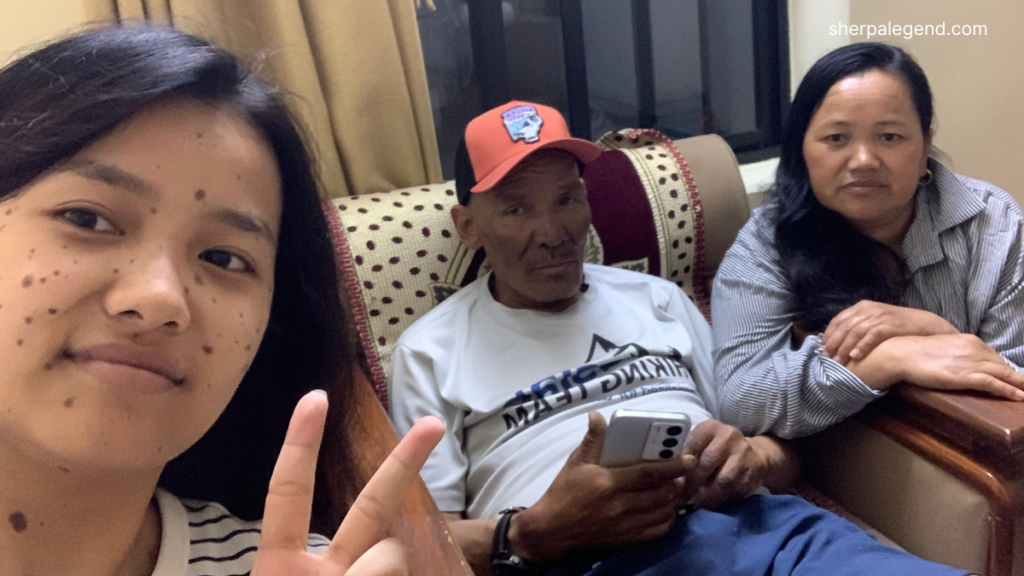
His family, who are described as a simple, close-knit household without an easy way to reach the wider world on their own, have relied on friends and organizers to help spread word of his story and the fundraiser set up on his behalf. They have also thanked the organizing team behind the GoFundMe campaign for helping promote it, saying they still find it hard to believe that so many strangers chose to help.
Where the Fundraising Money Is Going
An official organizing committee formed to manage the fundraiser and ensure transparency around how the money is used. It is led by Stephen Sellman as organizer, with Dawa’s daughter, Mendo Lhamu Sherpa, serving as co-organizer, and Nurbu Sherpa acting as coordinator. Chris Thrall, Michelle Haslam, and Everest Live’s Ben Ayers are also supporting the effort.
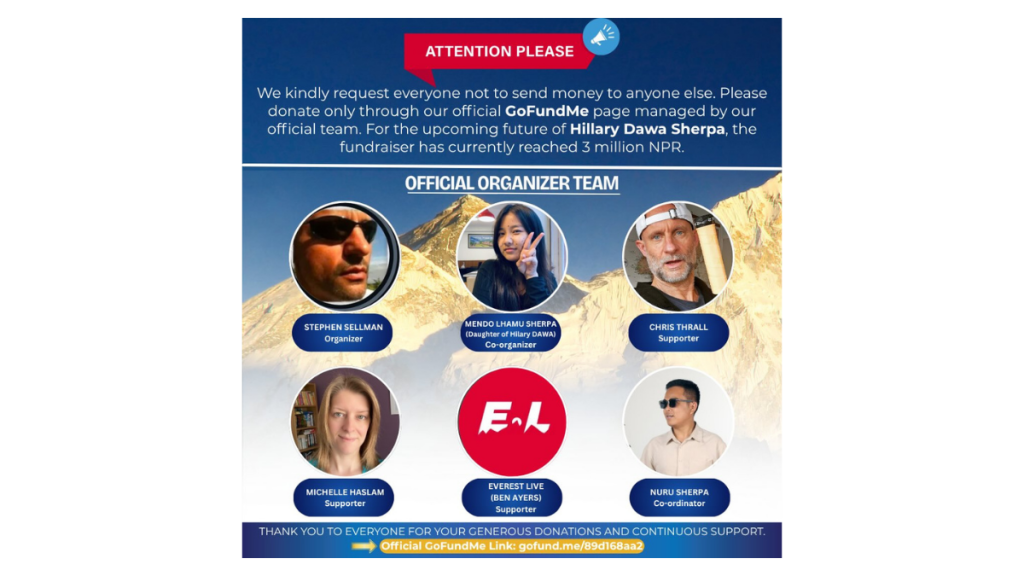
According to Nurbu, Dawa’s hospital and medical expenses are expected to be covered by insurance, so the fundraising money is not being used for immediate treatment costs. Instead, the goal is longer-term. The intention, in Nurbu’s words, is that Dawa will not have to risk his life on a mountain again to support his family.
More than 40,000 euros raised through the campaign in Nepal is being deposited into a fixed deposit account under a family member’s name, to be saved for the future rather than spent immediately. Nurbu explained that the money is meant to be set aside and used only in case of emergency, with the family having agreed together on how it will be handled. A significant part of the plan is securing the future of Dawa’s daughter, Mendo Lhamu, including her continuing education.
Mendo Lhamu recently turned 18 and completed her School Leaving Examinations, known in Nepal as the SEE. She is now studying Hotel Management at V.S. Niketan College. Supporting her education is one of the clearest priorities the family has identified for the funds raised in her father’s name.
There is also a more personal project taking shape. According to those close to the family, there are plans to write a book about Dawa’s story, so that what happened to him and the years of quiet work that came before it can be shared with a wider audience.
Will He Climb Again?
For a man who nearly died on the world’s highest mountain, the answer might seem obvious. But Dawa’s relationship with the mountains is not that simple, and neither is his answer.
Before this accident, Dawa’s high-altitude climbing had mostly involved smaller peaks rather than the biggest mountains.
On Everest itself, he had worked three times as a cook, and over the course of his life he had reached the South Col seven times as a porter, carrying loads rather than leading clients to the summit. He is, by description, a very straightforward, shy, and introverted man, with no formal education, who has spent his working life doing physical labor in the mountains rather than seeking attention for it.
Even after everything he has been through, Dawa says he wants to go back to trekking. Not necessarily back up into the death zone, but back onto the trails he knows, guiding people through the mountains that have shaped his entire life. “I want to go trekking, guiding people to trails,” he said.
It is a modest ambition from a man whose survival story reached climbers and readers around the world. But for Dawa, the mountains were never about records or headlines. They were, as he put it, what he cares about his work, his life, and now, after everything, still something he is not ready to walk away from.
For now, though, the focus is simpler healing, rest, and time with the family that spent seven agonizing days not knowing if he was alive. The rest, including any return to the trails, will come later.
Reporting for this story is based on interviews with Dawa Sherpa, his family members, and information shared during Dawa “Hillary Dawa” Sherpa’s first public interview with Ben Ayers for Everest Live.
