
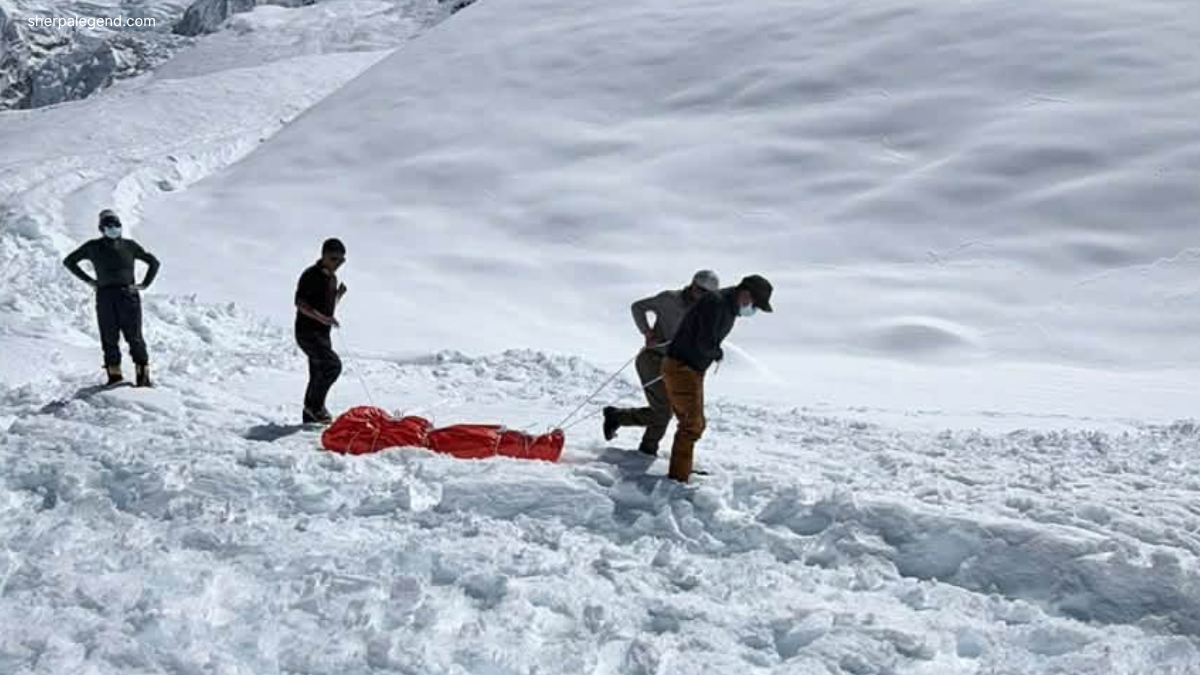

Rain had fallen for days in the lower valleys. Higher up, snow came in thick waves, and for three days the sky never truly cleared. At the Himlung Himal base camp, about 4,800 m up, the kitchen and dining tents stood in neat rows on flat ground.
The fabric was still tight and new. Sacks of rice, gas canisters and coils of rope were stacked inside. The camp was nearly ready for a season that had not yet started. The air was damp and cold, and the snow muffled sound.
The foreign climbers had not arrived. Only the support staff were there, and the camp was quiet. Above it, the upper slopes of the mountain were hidden in cloud.
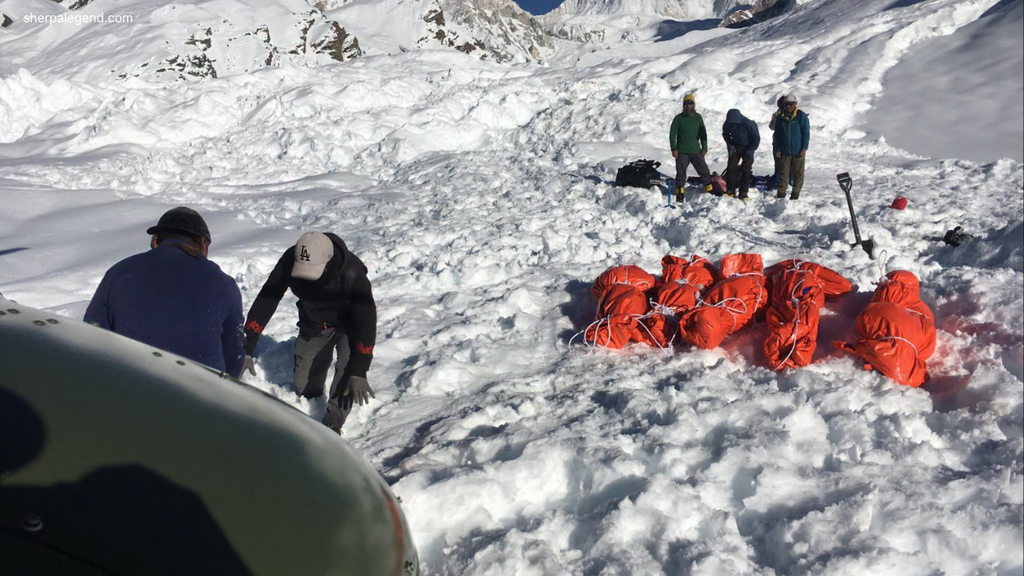
Then the snow came down. There was no loud warning. The avalanche struck early on September 27 with very little noise.
They were not swept away. They were buried where they slept and worked.
On September 27, heavy snow came down on the base camp of Himlung Himal, a 7,126 m peak in Narpa Bhumi Rural Municipality-5, Manang district. It collapsed on the kitchen and dining tents.
Sixteen people were buried 14 kitchen staff and two climbing guides. All of them were Nepali. No foreign climbers were at the camp. Reports say the staff were preparing the camp and the route for the autumn climbing season, including for a planned group of foreign clients.
Reports describe a large slab avalanche that came after several days of heavy rain and snow from a weather system over the Bay of Bengal. It struck at the base camp, at about 4,800 to 4,900 m, in the Nar-Phu area near the Nepal-Tibet border.
Twenty-seven people were in camp. Twenty-one were with Himalayan Holidays and six with Imagine Nepal. Eleven survived, seven from Himalayan Holidays and four from Imagine Nepal. That leaves 14 of the Himalayan Holidays group and two of the Imagine Nepal group among the 16 who were buried.
Chheten Lama Bhote, one of the survivors, said those who got out were slightly to the side, not directly beneath the falling snow.
The workers were buried inside their tents, which allowed rescuers to recover them from the camp itself. Fifteen have now been recovered. One is still missing. The NNMGA sent a specialised rescue team to the site to lead the search.
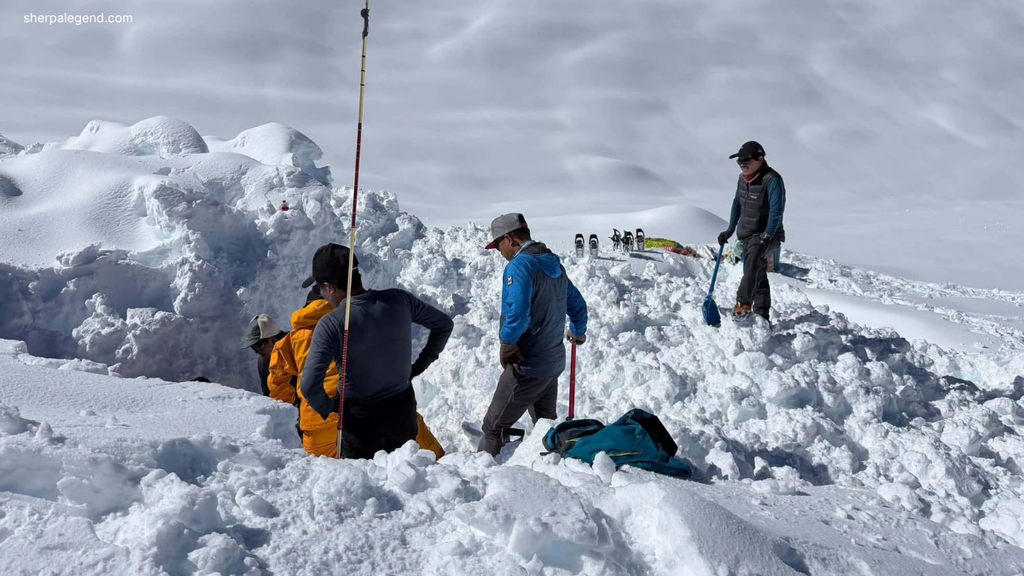
These are the people who make the climbing season work. Kitchen staff and guides get a base camp ready before any client arrives. They were at Himlung preparing the camp for the start of commercial expeditions. Fourteen of the 16 who were buried worked in the kitchen.
Home districts have been confirmed for seven of the dead. Chhebi Bhote and Pasang Bhote were from Sankhuwasabha. Ghanashyam Rai and Suraj Rai were from Khotang. Birendra Gurung and Aash Gurung were from Gorkha. Kalam Budha was from Rukum.
The Nepal National Mountain Guide Association (NNMGA) lists eight more among the 15 recovered Birkha Dhoj Tamang, Jagat Tamang, Lak Kumar Rai, Ngima Dorje Tamang, Santa Bir Tamang, Urkha Dhoj Bohara, Prem Tamang and Kirte Sherpa. The reports did not give their home districts. Spellings of names vary between reports.
One man is still missing Pasang Nuri Sherpa of Okhaldhunga. Rescuers found his tent and his bedding. They did not find him.
The NNMGA began the search and rescue operation after the avalanche. Phase I was led by Mingma Gyalje Sherpa, known as Mingma G, with a team of eight IFMGA-certified guides. They recovered four workers. Then bad weather stopped the work for a day. Reports from the site describe deep snow, layers of ice, cold and unstable ground slowing the digging.
Phase II began at the request of the families and Himalayan Holidays. Pasang Kaji Sherpa and Bikram Karki were mobilised to continue the recovery. By September 30 the total had reached seven. On October 1, a team of 10 led by Pasang Kaji Sherpa recovered eight bodies in a single day. Assistant Chief District Officer Krishna Prasad Paudel said four were found in the morning and four in the afternoon. The total stood at 15.
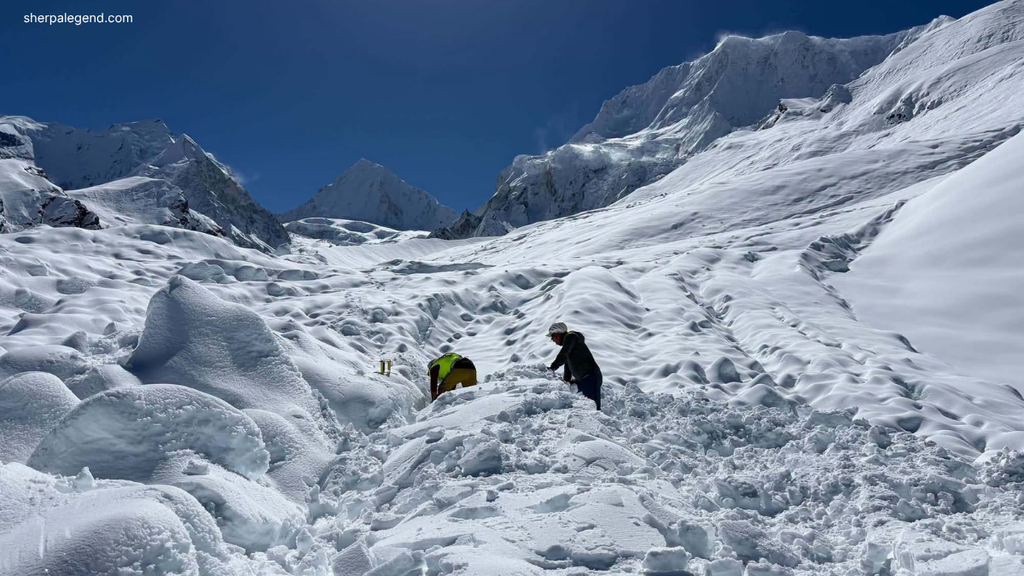
The conditions were hard. The teams worked in more than 14 feet of snow, in cold, on unstable ground. The NNMGA said they made every possible effort to bring home those who had died.
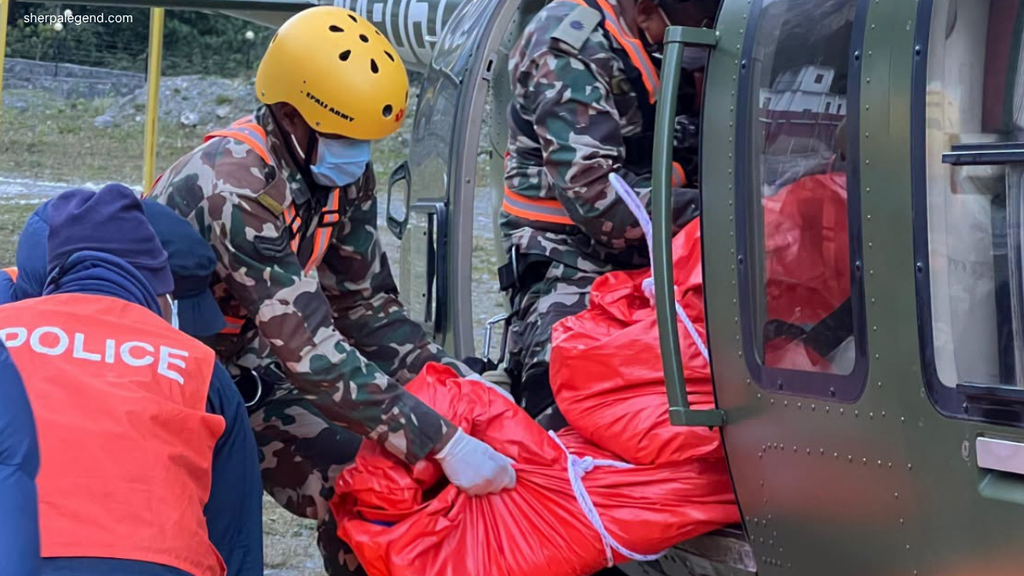
The Nepali Army flew the bodies out by helicopter. Earlier in the operation, helicopters had taken seven of the recovered bodies to Kathmandu. Six went to Phu Gaun and two to Chame. Paudel said flights could not continue after dark and that the remaining bodies would be brought out on Friday.
The NNMGA’s list credits the rescuers by name. In Phase I: Mingma G. Sherpa, Pimba Tenjing Bhote, Ashish Gurung, Pasang Rinzee Sherpa and Dandu Sherpa. In Phase II: Pasang Kaji Sherpa, Bikram Karki, Ngima Tashi Sherpa, Dawa Sange Sherpa, Dawa Jangbu Sherpa, Kaji Sherpa, Da Nurbu Sherpa, Tarke Sherpa, Dawa Tenji Sherpa, Tashi Tenjo Gurung and Balaram Gombu Tamang.
The people digging were mountain guides. The people they were digging for worked in the same trade. They were looking for their own, not for strangers.
The weather behind the avalanche was not a surprise. Around September 20 or 21, a low-pressure area formed over the northern Andaman Sea and the Bay of Bengal. Nepal’s Department of Hydrology and Meteorology and India’s Meteorological Department began tracking it.
Forecasts warned of heavy to very heavy rain across large parts of Nepal from about September 24 to 28. Some models projected 400 to 600 mm or more in places over four days. Rain later passed 100 mm at many stations, and some places recorded 400 to 500 mm or more.
On September 22 and 23 the system strengthened into a deep depression. It came ashore near Kalingapatnam on India’s east coast late on the 23rd and early on the 24th. It then moved inland and weakened, but kept feeding moisture north into Nepal.
Nepal’s meteorology department issued alerts for heavy to very heavy rain and for heavy snow in the Himalayan regions. The worst impacts fell on September 25 to 27. The system never became a named cyclone, but it still brought heavy rain to lower areas and heavy snow to the high mountains.
Reports say expedition operators and authorities issued urgent warnings about rain below and snow and strong winds high up, and that many teams took precautions. On other mountains, teams stayed low or retreated as snow piled up at their base camps. The same system also brought floods and landslides at lower elevations, with dozens of deaths reported across the country.
The point is that the danger was public. It was in the forecasts and in the warnings before the snow fell.
According to people in the trade, operators told staff to come down before the snow. The reports available for this story do not include a statement from either company, and no one has been named on this point. If it is true, the question is why anyone stayed. The reasons do not look like carelessness.
The camp was already set up. The tents were up, the food and gear were in place, and walking away meant leaving everything behind. Clients were coming. Many workers are paid by the season, so a missed expedition means lost income. And the camp was their responsibility. The work they were there to do, getting the camp and route ready for clients who had not yet come, was the job.
From the camp, there was little to see. For three days the sky did not clear, and the upper slopes were hidden in cloud. The avalanche itself came with very little noise.
If you had been standing there, it would have been your decision. Nobody thought this would happen.
Two things have to be held together. The workers should not be blamed for staying. And operators cannot close the matter by saying they told staff to leave. The decision looked reasonable from inside the camp, and that is what makes it hard to read.
What the record shows so far is what the forecast said and where the workers were. It does not yet show who told them what, or who was in a position to say no.
In 2014, French mountain guide Paulo Grobel moved his base camp to the opposite side of the glacier at Himlung after finding the usual site covered in avalanche debris. Coverage of the 2026 disaster has pointed back to that move as evidence that the traditional site carried a known avalanche risk, and has raised questions about where the camp stood.
Himlung had no reported avalanche with casualties in roughly the past ten years, from 2016 to September 2026. That record may be why the concern faded. In autumn 2025, a major cyclone brought heavy snow to Himlung. Trails were buried, and some teams turned back from Camp I or ended summit pushes for safety. No avalanche struck the base camp that year. Himlung has become a popular and relatively non-technical 7,000 m peak for commercial expeditions.
So the question is a plain one. Who decides where a base camp goes, and when does a known risk become a reason to move?
Go back to the kitchen tent. The season was supposed to begin. The fabric was new and the supplies were stacked. Instead, families are waiting for helicopters. On Thursday, the flights stopped when it got dark, and the remaining bodies were to be brought out on Friday. Fifteen are recovered and named.
One worker has not been found. Rescuers located the tent and bedding of Pasang Nuri Sherpa, but not him. Officials have said the chances for him are slim and that the operation may be winding down, but the search for him has continued.
Above the camp, the upper slopes of the mountain are still in cloud.
