

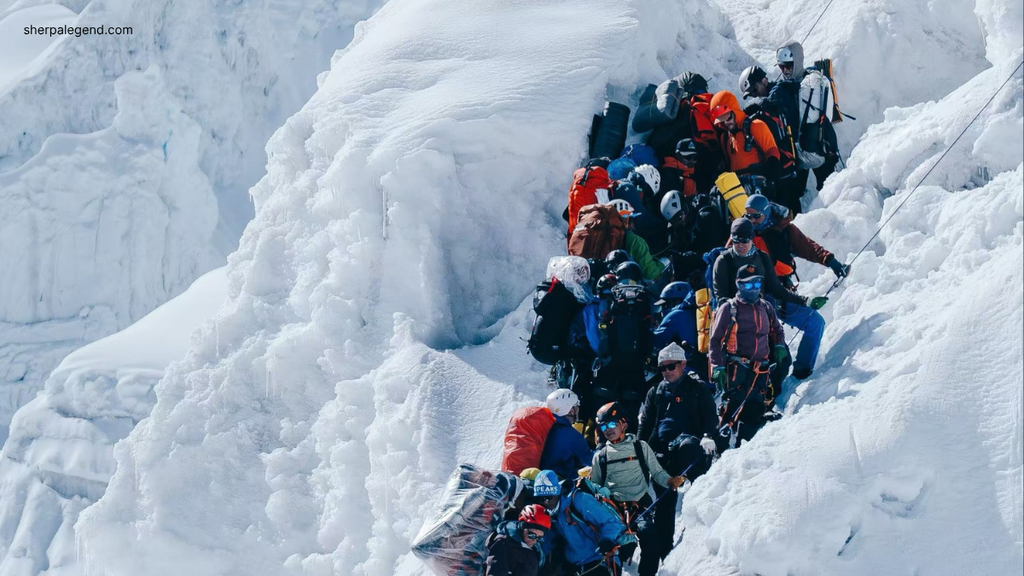
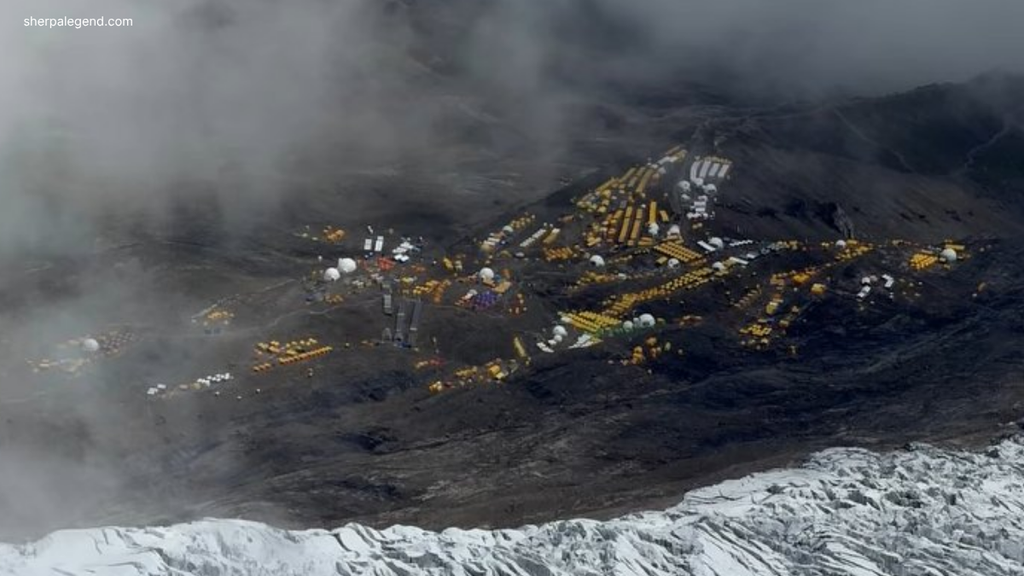
At 4,800 meters on the flank of Manaslu, the world’s eighth-highest mountain, this is the season of ambition. Hundreds of climbers have pitched their tents at base camp this week, gearing up for summit pushes on the 8,163-meter peak before the autumn weather window closes.
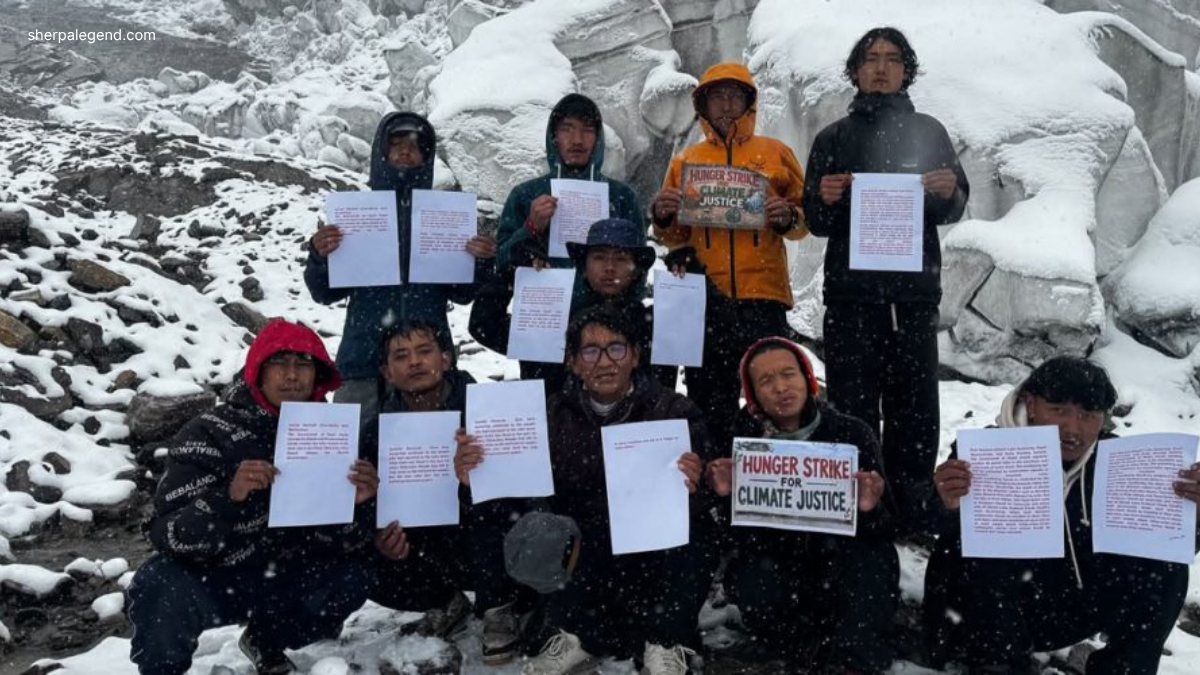
A hundred meters from that crowded, colorful sprawl of expedition tents, ten young Nepali men sit on bare, frozen ground. They have not eaten since Friday. The cold gets into boots and blankets fast at this altitude. At the center of the group, wrapped against the wind, sits Dawa Norbu Lama refusing food, refusing to move.
Lama, a youth leader from Samagaun in Gorkha’s Chumnubri Rural Municipality, has led nine others into an indefinite hunger strike demanding the Nepali government and the international community to act on the glacial lake threats hanging over their communities before disaster strikes here the way it struck the Bhotekoshi valley in late August, when flash floods tied to melting ice killed people and destroyed property downstream.
Samagaun is not an abstraction to Lama. It is home, and home sits beneath Birendra Lake, a glacial pool that has grown as the ice above it retreats. “Global temperatures are rising, causing glaciers to melt rapidly, and their effects are increasingly being seen in lakes and rivers,” Lama said. “It is necessary to inform people about disaster preparedness and risk-reduction measures.”
Before he sat down on the glacier, he and the group tried the official route they handed a memorandum to every level of local authority they thought could plausibly act. No one has responded. The hunger strike, they have said, will not end until someone does the same last-resort logic that has driven protesters onto empty stomachs in movements far from this mountain.
The group’s roughly eight demands sort into three broader asks. The first is simply to know the danger they want Birendra Lake in Samagaun, Kal Lake in Prok, and Hariyo Lake in Pungen surveyed and studied for outburst-flood risk, joint monitoring with China of glacial lakes across the border near Nepali settlements, and aerial surveillance of lakes throughout the Manaslu region and the neighboring Tsum Valley.
The second is to prepare people, by folding climate-change education and disaster-preparedness training into the curricula of community schools across the Himalayan region. The third looks outward: Lama has urged the government to press developed nations, the world’s largest emitters, for compensation and climate justice.
Late last month, that fear stopped being hypothetical. The Bhotekoshi flash floods, driven by the same warming Lama describes, killed people and destroyed property downstream. To the group at Manaslu, it was proof of what an unwatched glacial lake can do to a valley below it.
GLOF, explained: A glacial lake outburst flood happens when a lake dammed by ice or loose rock suddenly breaches, sending a wall of water and debris down a valley with little warning. Rising temperatures are making these lakes bigger - and the risk greater.
The demand for climate justice is about to get a bigger stage than base camp.
On September 22, Nepal’s prime minister, Balendra Shah better known as Balen Shah, the 35-year-old former rapper who became Kathmandu’s mayor and then rose to the country’s top office after the youth-driven uprising of 2025 leaves for New York to join the high-level week of the 81st United Nations General Assembly.
He is expected to press the Bhotekoshi floods as evidence, seeking compensation for Nepal through mechanisms like the Fund for Responding to Loss and Damage, and arguing that countries like his own contribute little to global emissions yet absorb outsized harm.
It is a strange mirror. The politician a Gen Z movement helped put in office is about to ask the world, in a suit, for the same climate justice that ten Gen Z Nepalis are asking their own government for, in the cold, on a glacier one indoors under UN lighting, the others outdoors under Himalayan sky.
A handful of ingredients could carry this story past Nepal’s borders the optics of hungry young men fasting a hundred meters from an expedition industry chasing a summit; the timing, landing the same week Nepal’s own prime minister carries the same argument to the UN; the messenger, a former rapper turned head of state, a product of the same youth politics as the strikers; and the frame underneath it all a generation’s claim to a livable future, set against a system too slow to act on it.
At bottom, it is an image of a boy in the cold, staking his body on his community’s right to survive.
No one has told Lama’s group that their demands will be met. As of this week, the memorandum sits unanswered, and the strike sits open-ended the group has said it will not stop until someone acts. Base camp will keep filling with climbers chasing the summit window. Balen Shah’s flight will leave for New York on schedule. And at 4,800 meters, ten young men will still be sitting on the frozen ground, not eating, waiting for an answer that, for now, has not come.
