
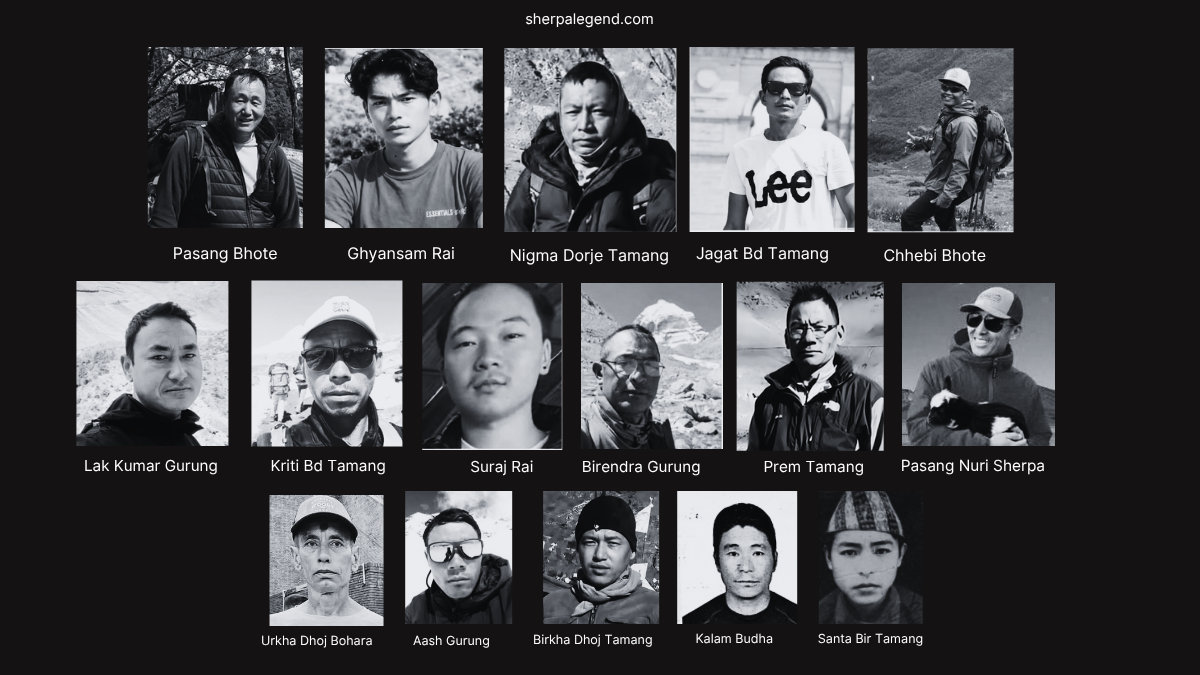

They went up early to get the camp ready for the climbers. They did not come home.
Before any climber arrived at Himlung Himal Base Camp, sixteen Nepali workers were already there. They had come early to prepare the camp. The clients were due on October 1.
Snow had fallen heavily since September 24. The path down was buried, so the workers stayed another night. They kept watch and cleared snow off their tents. Then, in the night of September 27, snow came down on the camp, about 4,900 metres up in Manang. It buried the kitchen and dining tents where many were sleeping. Fifteen bodies have been recovered. One worker is still missing.
These are the sixteen.
Pasang Bhote, 31, and Chhebi Bhote, 52, were climbing guides with Himalayan Holidays. Both were from Bhotkhola, Sankhuwasabha. They were cousins of survivor Chheden Lama Bhote.
Fourteen were kitchen staff. Twelve worked for Himalayan Holidays. Birendra Gurung, 30, was from Dharche, Gorkha. Ghansyam Rai, 45, Suraj Rai, 21, and Lak Kumar Gurung, 40, were from Aiselukharka, Khotang. Birkha Dhwaj Tamang, 35, Ngima Dorje Tamang, 46, and Jagat Bahadur Tamang, 34, were from Temal, Kavrepalanchowk. Urkha Dhoj Bohara, 57, was from Sindhupalchowk. Kalam Buda, 57, was from Rukum. Santa Bir Tamang, 41, was from Dolakha. Prem Tamang, 63, and Pasang Nuri Sherpa, 38, were from Okhaldhunga. Pasang Nuri Sherpa has not yet been found.
Two worked for Imagine Nepal. Ash Bahadur Gurung, 58, was from Dharche, Gorkha. Kirti Bahadur Tamang, 47, was from Dolakha.
The youngest was 21. The oldest was 63.
One of them, Lak Kumar Gurung, loved to travel. He came from a family of British Gurkha soldiers and ran a small shop in Kathmandu outside the trekking season. He was a father of two, a 10-year-old daughter and a two-year-old son. His flight to Britain was booked for October 21. “His flight was scheduled for October 21, but this happened,” said Shree Kumar Rai, a neighbour from his village.
Eleven workers survived because their tents were pitched farther from the main camp. The kitchen and dining tents had been moved near a new water tap, so the workers would not have to walk for hours for water. That small comfort put them in the path of the snow.
These workers are paid only a few hundred dollars in a season, and many are paid by the day. Since February, the government has set minimum accident insurance at Rs 2 million. But the Department of Tourism says no special decision has been made yet for the Himlung families.
“They are equally important members of the climbing community,” said Abiral Rai of the Nepal National Mountain Guide Association.
So we are left with questions.
Who will explain to a ten-year-old girl and a two-year-old boy why their father did not fly out on October 21?
Who will care for the families of sixteen men, from Sankhuwasabha to Rukum, whose only income came from the mountain?
Who will watch over the next kitchen tent, and who will decide where it is pitched?
And when the next expedition season begins, who will stay to cook, carry and prepare the camp, if their families are left with nothing?
Sixteen men went up first. The least we can do is remember every one of them.
