
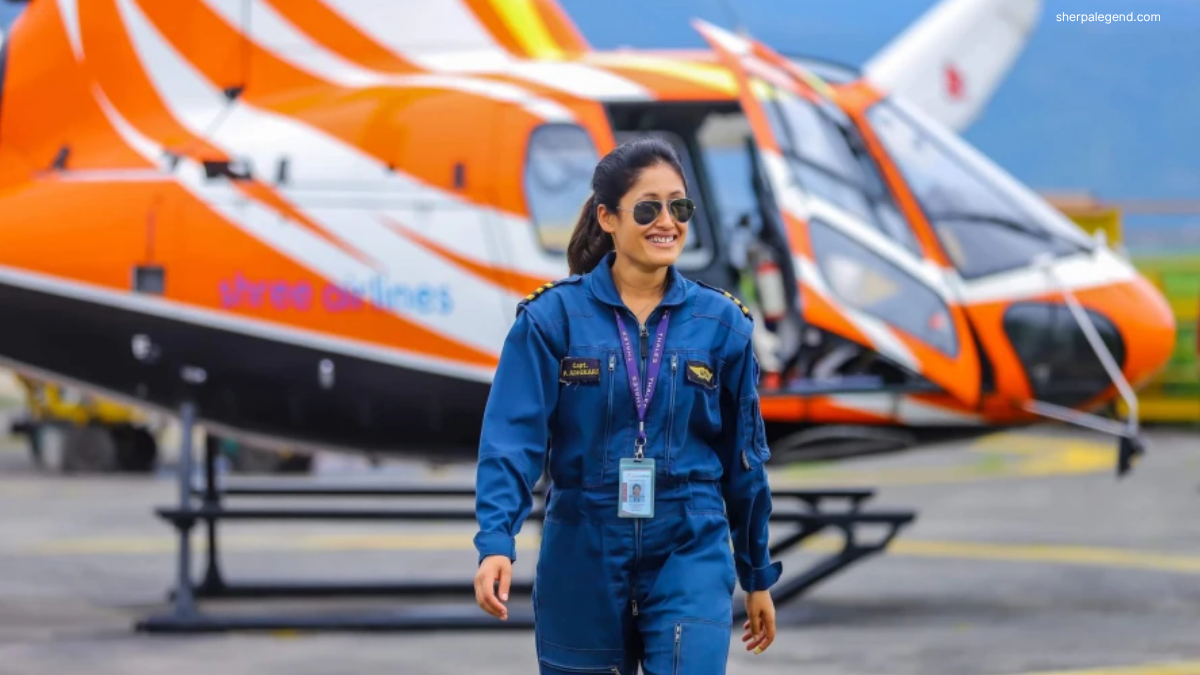

Below Priya Adhikari’s helicopter, Timure was gone. In its place was mud a grey, sucking mess that had buried roads, houses, and the hydropower plants that once lit up this stretch of the Nepal-China border.
She brought the aircraft down anyway, one of nearly twenty helicopters working the same narrow valley that week, sometimes five or six landing almost at once, radios crackling non-stop so no two pilots tried to touch down in the same spot.
The mud was too soft to trust, so she kept the engine powered up the whole time, ready to lift off the second the ground gave way. People below were waving up at her. She looked down and said the only thing that mattered “You survived.”
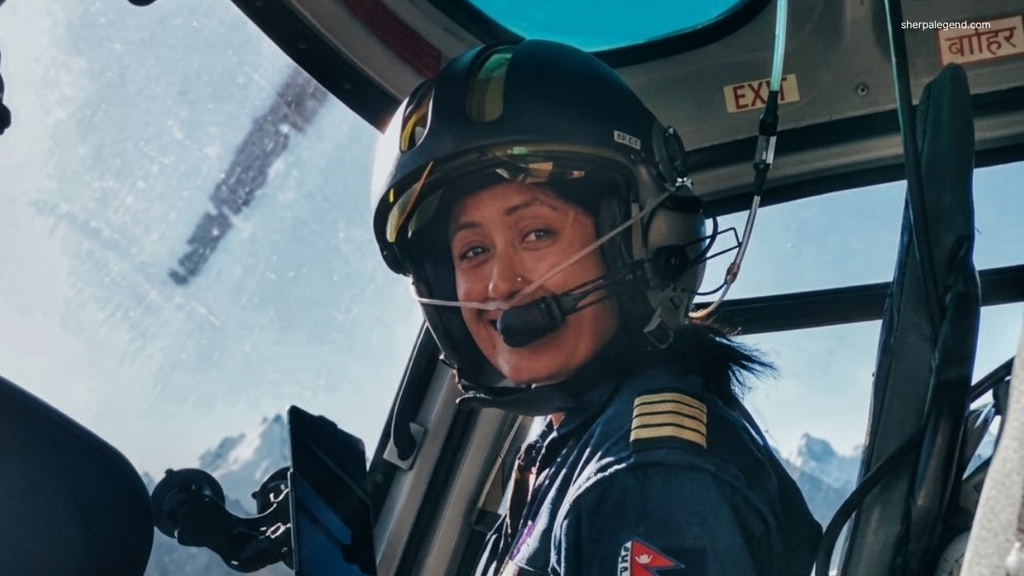
Adhikari is Nepal’s first and only female helicopter captain, a pilot with more than 1,000 rescue missions behind her before this disaster even began. In late August and early September 2026, she became one of the faces of the country’s response to one of its worst natural disasters in years flying roughly 100 rescue missions in about six days over the flooded Bhote Koshi valley.
The disaster began high above the valley, where a collapse of ice and rock sent a huge wall of debris crashing down the Bhote Koshi river system.
The surge tore through the Nepal-China border region, hitting Timure, in Rasuwa district, hardest. More than 1,000 people died and thousands more were reported missing. “Everything is gone,” Adhikari told India Today. ” hydropower projects are gone, lives are gone.” With roads and bridges destroyed, helicopters were the only way in or out.
For six days, Timure’s sky was full of aircraft. Around 20 helicopters operated over the area at once, pilots talking constantly over the radio to keep from colliding as they searched, landed, and lifted off again. At times, five or six aircraft came down almost together. The ground itself worked against them thick mud made every landing a gamble, so pilots stayed powered up rather than shutting down, ready to pull out fast if the surface gave way.
More than 200 survivors were flown out of Timure in the first two days alone, with Nepal Army Augusta helicopters joining private operators like Adhikari in the effort.
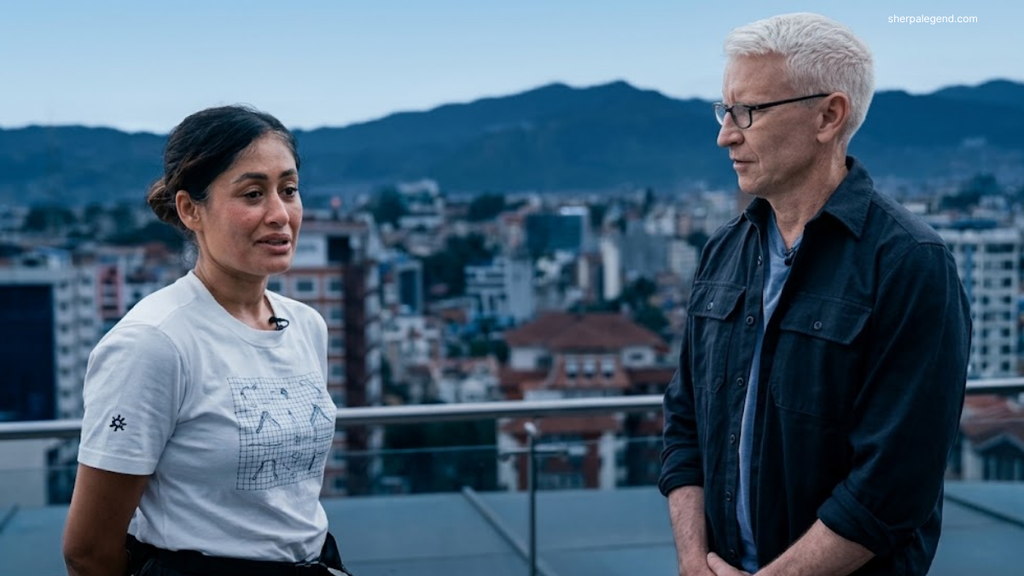
She described the scale of it to CNN’s Anderson Cooper as unlike anything she had seen before in some ways worse than the 2015 earthquake, because this time the destruction was packed into one narrow valley rather than spread across the country.
The work was exhausting and grim in equal measure. “Most of us are so exhausted because of all the flights we’ve been doing,” she said. “We’ve been trained for this.” From the cockpit, she saw bodies scattered across the wreckage even as she carried the living to safety. Every landing, though, brought a small piece of relief a stranger looking up at her, and the two words she gave back to them: “You survived.”
Priya Adhikari Interview with CNN’s Anderson Cooper
This was not the first time Adhikari had flown into danger. Long before Timure, there was a cold winter morning in Kathmandu when friends asked her to join them on a helicopter ride. She was in her final year of a Bachelor’s degree in Environmental Science at the time, working as cabin crew for a domestic airline, and had been planning to study further abroad.
Somewhere over the city that morning, she turned to the pilot and asked a question that would change her life: how do you become a helicopter pilot?
Four months later, she was in the Philippines, training for a career almost no Nepali woman had entered before her. It was not cheap, and it was not easy. “We sold some of my mom’s gold,” she said. “There were doubts, there was a lack of money, but everyone came together.
All my family members came together and supported me. So without them, I wouldn’t have done it.” When she first told her mother about the idea, the reaction was disbelief more than anything. “Just because of one helicopter ride, no one decides, right?” her mother said and then helped her do exactly that.
Adhikari started in aviation as cabin crew in 2006, straight out of college, and worked her way toward the cockpit over the following decade, completing an MBA along the way because, as her mother always told her, education “will give you right way and will always remain with you.” She became a full-time helicopter pilot and, in 2017, a captain the only Nepali woman to hold the title.
Adhikari’s specialty is high-altitude search and rescue, flying into the Himalayas to bring down injured and stranded climbers, including from Everest, where her rescues have taken her up to roughly 6,200 metres.
That work has shaped almost everything about how she flies. At extreme altitude, thin air means a helicopter can carry far less weight before it becomes unsafe, so before every flight she calculates fuel and passenger weight against what the aircraft and the altitude will actually allow.
In the mountains, weather turns without warning fog rolls in, winds pick up, an avalanche lets go somewhere nearby and years of flying through it have trained her instinct to divert or land rather than push on.
“If I have this kind of weather, then I divert or I land. Done,” she said. “If I get any kind of emergency, I am trained enough to go and land somewhere safely. So no, I’m not scared.”
She has also landed in some of the most unstable terrain there is high camps, glaciers, ground that shifts under an aircraft’s skids. It is not hard to see where that experience was drawn on over Timure, where the same instincts read the ground, calculate the weight, know when to hold back and when to go in were the difference between a safe landing and a disaster in the mud.
None of it came easily. When Adhikari started out, she says male helicopter pilots gave her almost no support. “There was no support from any of the male helicopter pilots. I can say no one supported me truly.” What changed their minds, she says, was simply showing up and doing the work, flight after flight, year after year.
“When they saw me consistently working hard, they saw that, ‘Oh, this girl is here for good. This girl is here to work hard.’ Then they started accepting me.” Today, some of those same pilots are close friends friends she sees off the clock, too.
Adhikari lives in Kathmandu’s Baluwatar neighbourhood, in a house she bought four years ago, with her parents living alongside her.
With two fellow pilots, she co-owns a restaurant franchise, The Chicken Station an idea born during the COVID-19 pandemic, when their pay was cut and they started talking about a backup plan at the helipad.
She still checks in on the restaurant regularly, going over the books and talking to staff. To manage the stress of flying the same demanding schedule day after day, she has boxed several times a week for seven years, at a gym in her own neighbourhood. “Instead of going home and resting and sleeping, I felt like if I go boxing, that stress it takes it out of me,” she said. “Boxing is for physical fitness, to be fit, to be athletic, to be able to have that power and confidence in me. But at the same time, boxing is love.”
In 2008, she also decided to enter the Miss Nepal pageant. That year’s contest was ultimately cancelled, but she says preparing for it learning to speak in public and carry herself with discipline still shaped who she became in the cockpit.
Back over the Himalayas, on a clear day between missions, Adhikari still talks about flying the way she did the first time she asked a stranger how to do it. “I’m so blessed that I got a chance to fly as a helicopter pilot and to see this every day,” she said. “I think this is like heaven. So you cannot get enough of heaven, right?” Looking back, she says no one warned her how hard the job would actually be.
She does not sound like she regrets finding out. What she hopes for now is simpler that after her, no woman in Nepal has to ask permission to sit in the pilot’s seat. She has already answered that question herself, a hundred times over, in six days above Timure alone.
This story is based on Quotes to CNN (Anderson Cooper) and India Today are drawn from those outlets’ published coverage, Quotes on her early life, family, and career are drawn from a documentary profile by Authentic Documentary.
Watch her Documentary:
