
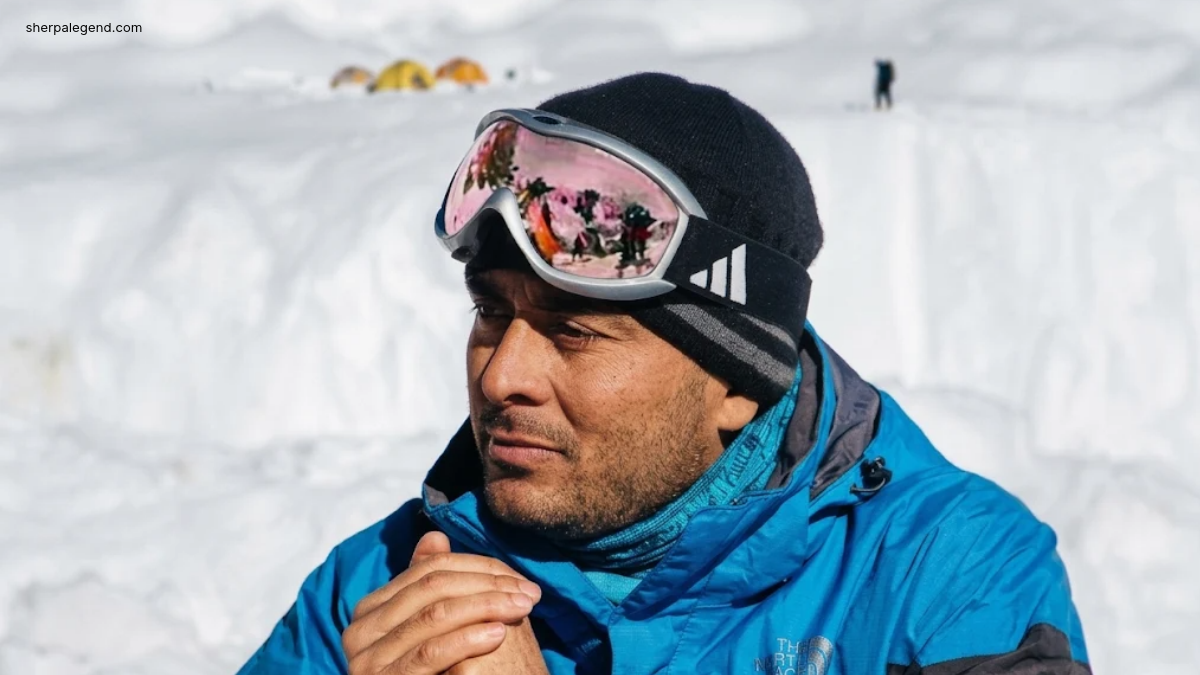

Two hours above the summit camp on Kanchenjunga, a small stone came down like a bullet. It made a sound as it flew. It hit the down suit of Colonel Ranveer Singh Jamwal, and the down came out. He stopped, shocked. Nobody was climbing above him. Where had it come from?
Fifty metres away, anchored to the same fixed rope, lay the body of a French climber who had died on the mountain days earlier. It was right there, in front of his eyes.
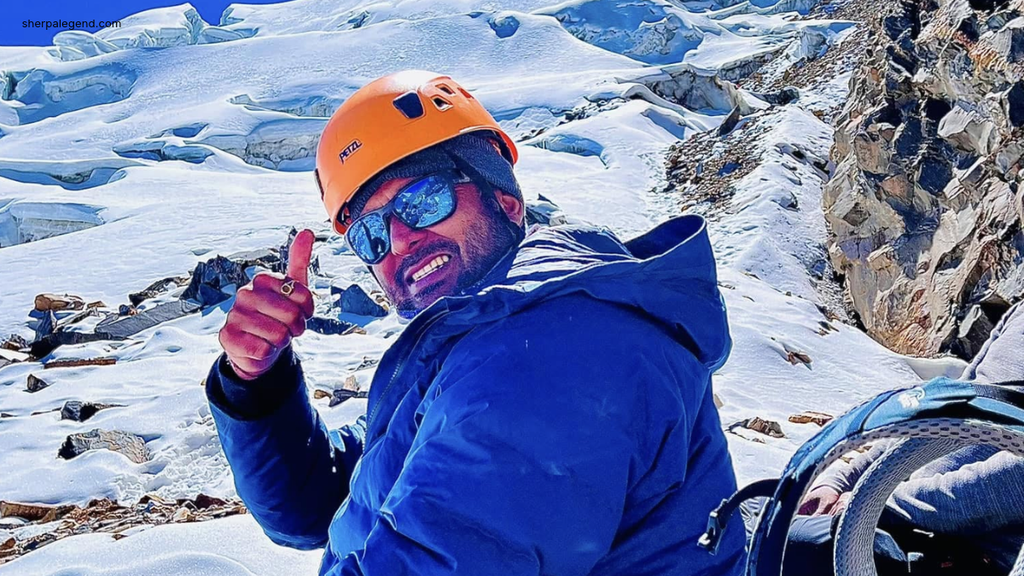
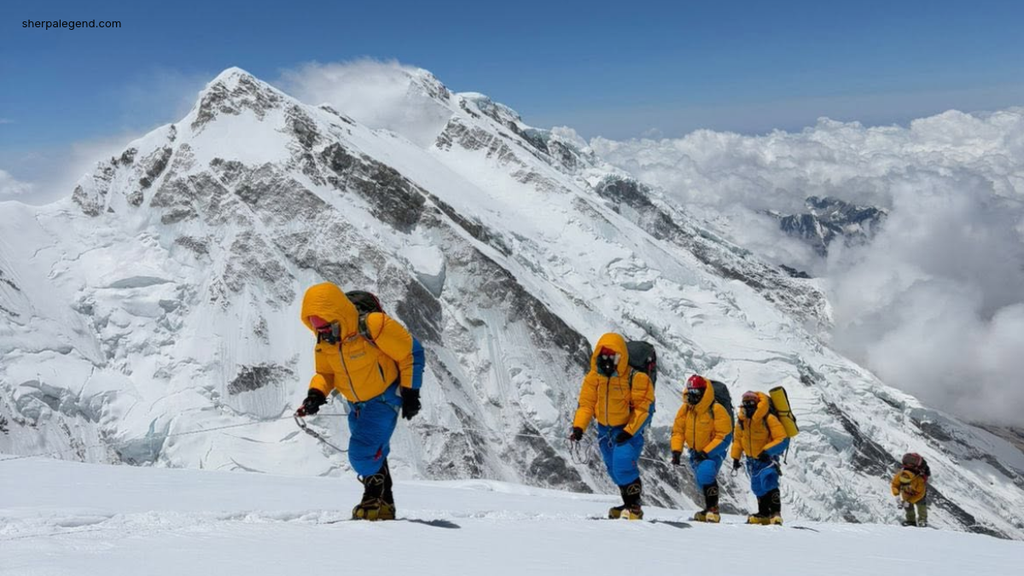
He took every step carefully. He kept his ears open for the sound of a small stone or a piece of ice coming down. He listened for his oxygen. If the sound stopped, the mask or the regulator might have frozen, or the mask might be leaking. He checked the climber ahead, the rope, and the jumar, the clamp that grips the rope.
A fit person can reach the top of Everest in 8 to 10 hours, he says. On Kanchenjunga the same person needs 14 to 16, on steep, near-vertical rock. On Everest you can stop, take your bag off and breathe. Here you are holding the rope and climbing a wall, and you cannot even place both feet flat.
The man climbing it was a village boy who didn’t know mountaineering existed.
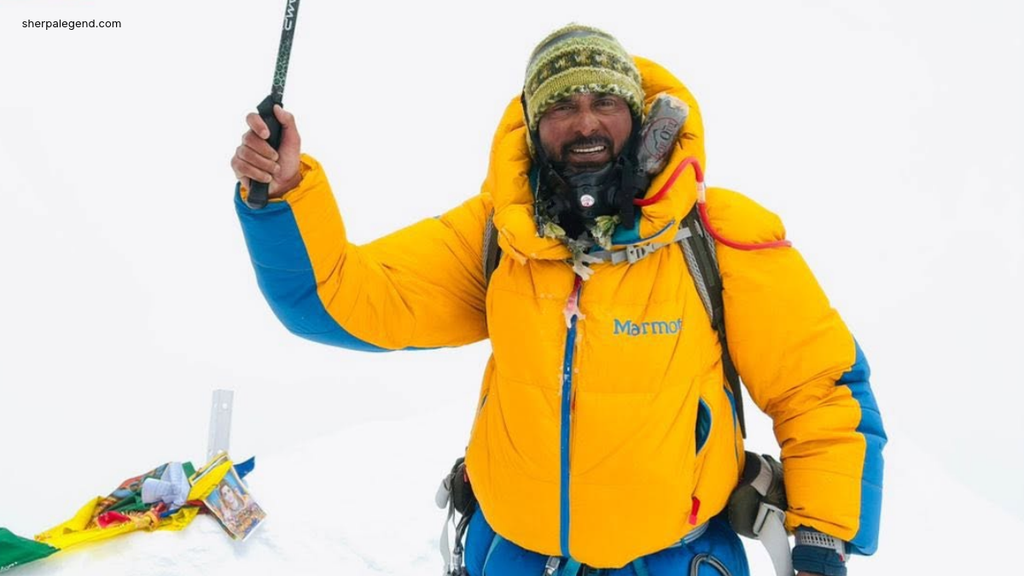
Jamwal is a colonel in the Indian Army and the Director of the National Institute of Mountaineering and Adventure Sports (NIMAS) in Dirang, Arunachal Pradesh. He has summited Everest three times, completed the Seven Summits and been on more than 70 expeditions.
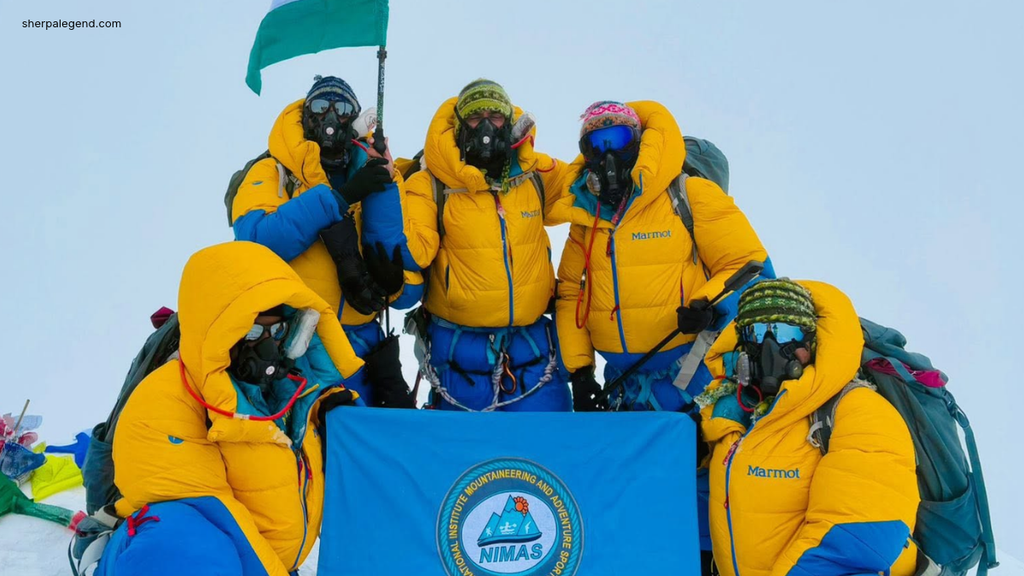
The reason to read about him is bigger than his record. His career shows how the Indian Army turns soldiers into mountaineers. It also shows how one officer is trying to move Indian climbing away from repeating known routes and toward exploration, rescue and self-reliance. One idea of his own holds it together. The goal is not the summit. It is bringing everyone back.
A village boy joins the ranks
Jamwal was born on 26 December 1975 in Badhori, a village in Samba district, Jammu and Kashmir. This is the Kandi belt: low, rocky hills, not snow peaks. He had an elder sister and a younger brother. As a boy he scrambled up the hillocks around the village and looked at the distant mountains.
Soldiering was the family trade. His grandfather and his father, Havildar Onkar Singh, both served in the Army. His father fought in the wars of 1962, 1965 and 1971. When he was away on duty, Jamwal’s mother ran the house and raised the three children.
Jamwal went to Army School, Ratnuchak, about 20 kilometres from home. He played football and threw the javelin. He says he did not even know the word “mountaineering” existed.
On 24 October 1994, aged 18, he joined the Army as a sepoy, a regular soldier, in 15 DOGRA, the 15th Battalion of the Dogra Regiment. He did not enter as an officer.
His officers saw potential in him and pushed him to try for a commission. While still serving in the ranks, he studied for the Army Cadet College exam, the route that lets serving soldiers become officers. He cleared it. In 1998 he entered the Indian Military Academy in Dehradun. Four years of training followed. In June 2002 he was commissioned a lieutenant in 11 JAT, the 11th Battalion of the Jat Regiment.
That is eight years from the day he enlisted to the day he became an officer. In those years his focus was ordinary infantry soldiering and earning his commission.
A slot nobody planned
In 2003, a year after he was commissioned, his unit received a routine training slot: the Basic Mountaineering Course at the High Altitude Warfare School (HAWS) in Gulmarg. Jamwal volunteered.
He found he was good at it. Ice, rock and snow came naturally. He went on to finish all four courses at HAWS, basic and advanced mountaineering and basic and advanced skiing. He graduated as Best Student, with an instructor grading.
The Army posted him back to HAWS as an instructor from 2006 to 2008. In 2007 he was picked for a mountain search and rescue course in Andermatt, Switzerland, where he trained with the Swiss Army.
No one planned this. A routine training slot became a career.
Mana, 2009
Mana was Jamwal’s sixth expedition and the first he led. It was also the Jat Regiment’s first-ever expedition. The peak, in Uttarakhand, is about 7,272 metres. Until then, he says, he had climbed for fun.
The team left for the summit at 3 a.m. and reached the top around 9. They took photos and started down. Then a blizzard hit. The radios stopped working in the extreme cold, so they could not call base camp for a weather report. Ahead was a wall of about 200 metres that they had to rappel, which means sliding down a fixed rope. Moving snow had buried the rope.
Seven of them made a small shelter under a rock. They had a small butane stove and used it to melt water to drink. They thought they would wait two hours. They waited about 15.
Jamwal felt a finger itching. He took it out and saw it was red. He knew frostbite, the freezing of skin and flesh, had started. Another man’s finger was hurting too. As leader, he says, everything falls on you.
They decided to move. They pulled the buried rope out of the snow. At the wall they could not see the fixed rope at all, so they anchored the roughly 200 metres they had pulled free and rappelled down on it. Jamwal and one other climber went first. They tugged the rope as a signal for the rest to follow. The rope was just long enough. He calls that luck. About 17 hours after the summit, they reached their tent.
That night he told them to do what he teaches as an instructor: soak the affected hands in lukewarm water, not hot. One man, who had said he was fine, went to sleep without doing it. He told Jamwal he had been tired and thought nothing would happen. In the morning four of his fingers had turned black. All four were amputated. Jamwal lost one finger. A third man, who had blisters, got treatment and kept his fingers.
“Before that, I was a casual adventurer and was doing it for fun,” Jamwal has said. “I made a strong resolve to bounce back and prove to myself that my choice was right.”
He promised himself he would climb at least one mountain every year. In 2010 he climbed Bandarpunch, Bhagirathi II and Kilimanjaro. By his count, Kanchenjunga was his 71st mountain.
Everest and the earthquake
In 2012 the Army Adventure Wing made Jamwal Deputy Leader and Chief Trainer of the Indian Army Women’s Everest Expedition. He had spent two years training novices. On 25 May, 21 climbers, including seven women officers, reached the summit. Jamwal summited Everest again in 2013 and 2016.
He describes his decisions on the mountain as calculated risks, not heroics. In 2012 a blizzard began as the team reached Camp 4, the last camp before the summit push. Colonel Kotiyal, at Camp 2, checked the weather report. It said the night would be dangerous and the next day cloudy. The team came down in the morning. That night, Jamwal says, four people who had gone up died, and about eight were rescued from Camp 2 by helicopter, frostbitten.
In 2016 a blizzard began as the team left Camp 3 for Camp 4, up a steep ice wall. Jamwal told them to keep going. At Camp 4 he phoned the base camp manager. The forecast was about eight hours of bad weather. They stayed. By morning the weather had cleared, and the team went for the summit that evening.
He made the same kind of call on Kanchenjunga. When a first summit attempt was scheduled, nobody could say whether the rope fixing was done or how far the rope went. He did not take part. One climber died. Another went missing and was found on the third day, frostbitten but alive.
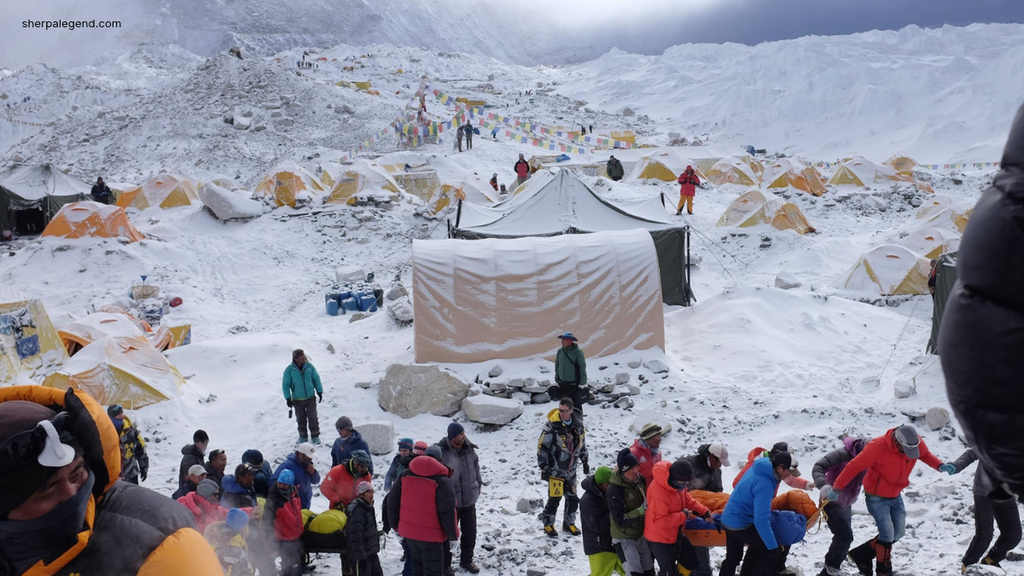
The call he remembers most came on 25 April 2015. His team was in the Khumbu Icefall, a glacier broken by crevasses, on its first day of acclimatization. The earthquake struck. The BBC first reported that 22 members of the Indian Army team were missing. Others assumed they would be the first to die, because crevasses are the most unstable in a quake. Two hours later the team walked out, drenched and covered in snow, all alive. Jamwal cried. More than 30 people were with him, including seven or eight Sherpas.
On the way to Base Camp they passed a chair, a mattress, a shoe. At Base Camp, 18 people were dead and more than 80 were injured. It had happened in about 20 minutes.
Many climbers started down. Jamwal told a senior officer on the satellite phone that he wanted to stay. Three of his team were hurt and their tents were wrecked. But the tent with the rations and the tent with medicine and spares had held. He had asked the team. They wanted to stay.
The first thing they did was put up the Indian flag. People who had lost everything were sent to the tent under it for food. They gave out medicine, water and juice, and let frightened climbers sit inside. Jamwal says only the Army team had stretchers. It also carried double its usual medicine. When someone asked if he had known something like this would happen, he said no. That is what the Army teaches, he said: prepare for contingencies.
Two or three more teams joined in. When the injured and the dead had been taken down, about 50 people were left. They cleaned Base Camp together. The Army team came down after 15 days.
Everest summits are common now, Jamwal says, and people value them less. Rescue earned the Army its respect. In 2016, he says, big European companies said they should camp near the Indian Army’s camp, for safety.
The Seven Summits and what they cost
The Seven Summits cost money as well as effort. Mount Vinson in Antarctica, his seventh, cost about ₹40 lakh (₹4 million). He paid with a loan, his savings and 10 to 12 lakh raised by crowdfunding. The climb took about a week. The cost, he says, “pinched.”
He had 12 days left in Chile. A friend from Bengal told him about Tres Cruces. Malli Mastan Babu, the first Indian to complete the Seven Summits, had died there. Jamwal decided to climb it as a tribute.
Tres Cruces is like a fort: a stone wall with one route. About 18 people went for the summit that day. A group of around 12, led by the director of a Chilean mountain school, lost the route and turned back. A team of four followed them. Jamwal and his Chilean guide, Mario, split up to search. An hour later Jamwal found the way through the rocks, marked only by a stick. He shouted for Mario. They reached the summit and paid tribute to Malli Mastan Babu. Jamwal climbed six 6,000-metre peaks in 10 days.
Denali, in Alaska, stands out. He climbed it unguided with two friends. They carried their own gear, hauled the sled and pitched their own tents.
NIMAS and the new frontier
Today Jamwal leads NIMAS, a government institute. Its instructors, about 54, are on deputation. It trains people in land, air and water adventure, from mountaineering and sport climbing to paragliding, scuba and rafting. He says it is the only institute in the country that covers all three. Its courses are subsidised.
Its projects follow the same pattern. Har Shikhar Tiranga, from 2022 to May 2025, put the national flag on the highest point of all 28 states. The last was Kanchenjunga, in Sikkim. In 2023 Jamwal led a cycling expedition of 5,374 km across six Southeast Asian countries.
In early 2025 he led a rafting expedition down the Brahmaputra, 1,040 km from Gelling, the first village in Arunachal Pradesh, to the Bangladesh border. Jamwal is not a rafter. For the first three days the raft kept flipping. He asked himself why he had taken on the trouble. Nobody had rafted the first 24 km from Gelling before. Two of the six Arunachal men on the team refused to go back in the water. Four stayed. At the border, a BSF company, the whole village and the district officials were waiting.
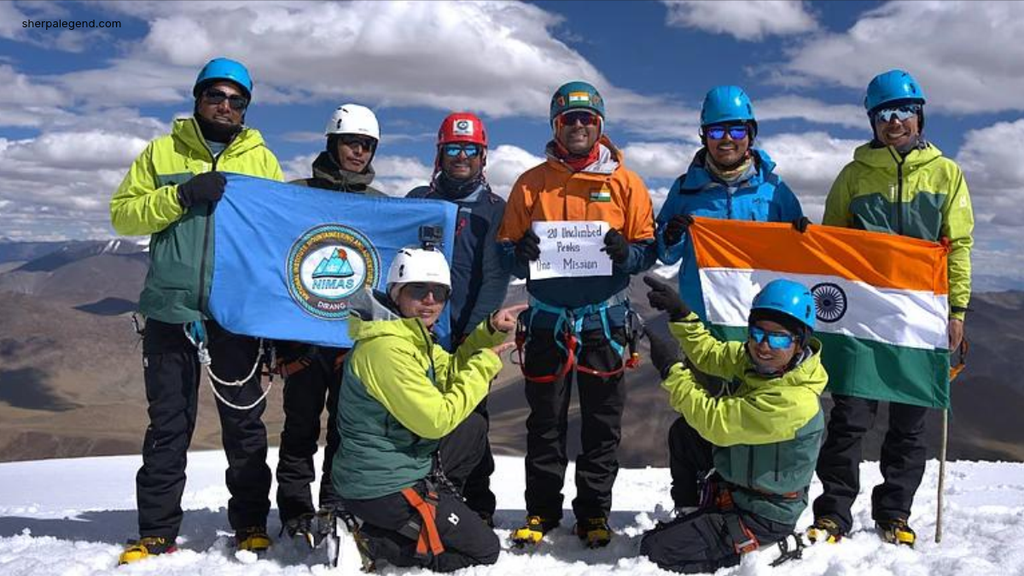
The newest project is in Ladakh. In September 2026 a team of 20 NIMAS instructors and climbers climbed 20 unclimbed peaks above 6,000 metres in 23 days. The plan used three clusters of peaks close together: Chamser–Lungser, Gyama Nala and Chokula. The team could move from one summit to the next without losing altitude or spending days walking between base camps. On Peak 6 (6,285 m) they met whiteouts and false summits. On the last, Peak 20 (6,198 m), they fixed 800 metres of rope up a steep ice wall. Defence Minister Rajnath Singh flagged in the team in New Delhi on 25 September 2026.
For Jamwal it was personal. “It had taken me almost nine years of mountaineering to complete 20 significant peaks,” he said afterwards. “And here we were, standing on our 20th summit in just 23 days. That thought was quite overwhelming.”
Why he needs to be talked about
First, rescue and responsibility. His measure of success is everyone coming home. On Kanchenjunga he fixed the order of the five climbers on the rope: Kewal first, then Jamwal, then Nepal, Sushil and Chosgel. Kewal set the pace. Chosgel, at the back, had one job: to signal when everyone had passed him. They moved together. Either all of them summited or none of them did.
Second, access and bureaucracy. Five of the 14 eight-thousanders lie in Pakistan, and Jamwal says Indian climbers cannot go there. K2 is one of them. Only nine of the 14 are open to Indians. “It’s not a skill issue, it’s a bureaucracy issue,” he says.
Third, opening the mountains to ordinary people. A 28-day mountaineering course at NIMAS costs ₹24,000, with food, instructors and equipment included. At other institutes, he says, the waiting list is two years. One man he met left a corporate job and has done six courses. Jamwal also wants routes written down. Old route files from 1995 sat forgotten. Now his teams post summit and route photos online, so others can see where to set base camp, which village to stay in and how to walk.
Jamwal says he hates the word “conquer.” “You can’t conquer, you are a survivor.” He says the mountain teaches you to walk bowed, and that it breaks arrogance on the spot.
He always calls his wife from base camp after a climb, because the path to base camp is dangerous. Usually he tells her he is safe and sound. After Kanchenjunga he had tears in his eyes. The first thing he said was: “I have returned alive.”
She told him he had never said that before. “Was it that dangerous?” she asked. It was, he told her.
