
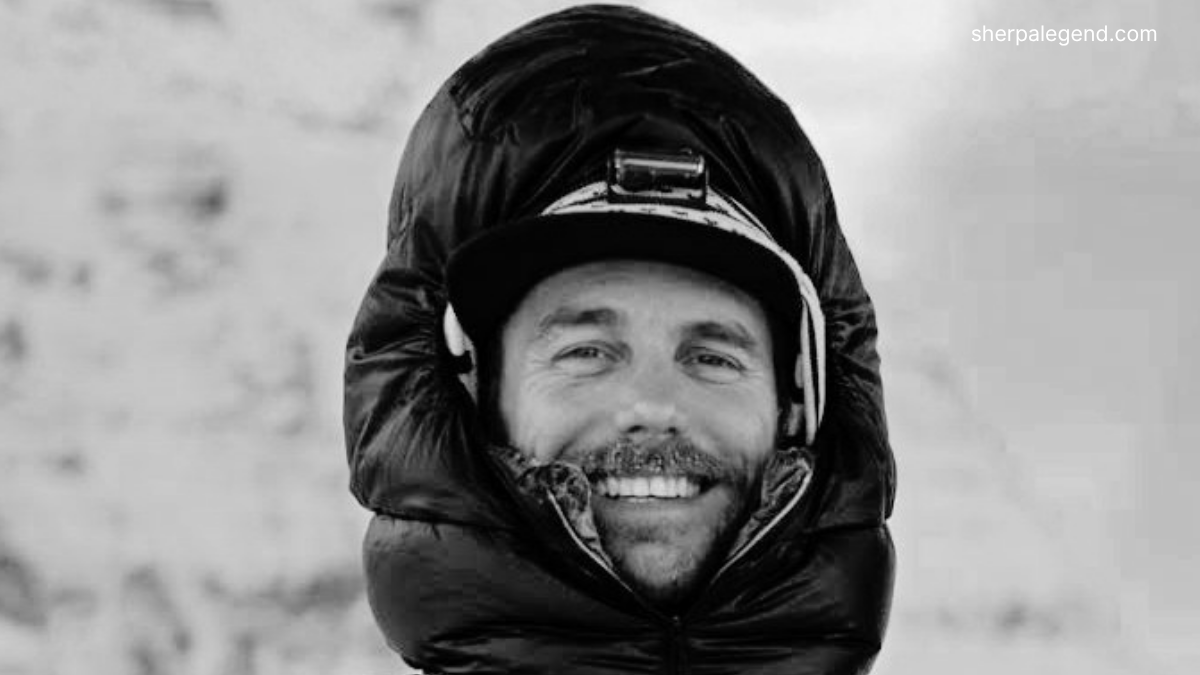

On the morning of June 24, 2026, an avalanche of snow and rock swept down a slope on K6 in Pakistan’s Karakoram range. It struck at around 5,000 metres, low on the mountain, during the early stages of the ascent.
It killed one person.
His name was Guillaume Pierrel. He was 42 years old. He had been skiing since he was kid.
How It Began
Guillaume Pierrel was born in 1983 in the Vosges region of eastern France a quiet, forested highland where the mountains are gentle and the winters are long. He started Nordic skiing at two. At four, he made his first significant mountain ascent. Whatever the mountains offered him, he understood it before he could articulate it.
He competed as a junior skier, became French Team Vice-Champion, trained as a ski instructor, then pushed further. He earned his IFMGA certification the highest professional qualification in alpine guiding and settled in Chamonix, the mountain town at the foot of Mont Blanc where serious alpinists gather and where ambition and danger share the same address.
He was known to everyone simply as Gee.
What He Built
The list of what Pierrel achieved is long and serious.
He completed all 82 Alpine 4,000-metre peaks and the three legendary north faces of the Alps in under six months. He ran the UTMB ultramarathon in 27 hours. He skyran Lenin Peak in Tajikistan at 7,134 metres. He made solo ski expeditions in the Andes, descending peaks above 6,000 metres in Bolivia and Peru alone.
In 2021, he climbed and skied Gasherbrum II — 8,035 metres — via a new route on the south ridge, alpine style, no supplemental oxygen, with a small French team. It was a landmark moment for ski mountaineering.
His first descents span continents and years. The South Face of Mount Robson in the Canadian Rockies. Lines on Aoraki/Mount Cook in New Zealand. Le Linceul on the Grandes Jorasses. The Niche on Les Drus. The West Face of Cho Polu in Nepal’s Khumbu Himal. He was often alongside elite skier Christina Lustenberger, who was with him on K6 when he died.
He also founded GEE Films Productions. He made documentaries about mountain heritage and the pioneers of ski mountaineering. He gave the mountains back a history while simultaneously adding to it.
This was what made him rare. He did not simply want to climb. He wanted to understand climbing. He wanted to pass it on.
June 24, 2026
The K6 expedition was a natural next step. Pierrel had been building toward the Karakoram’s 7,000-metre peaks for years. K6 technically demanding, infrequently climbed, elegant in its difficulty was exactly the kind of objective he chose.
He was ascending alpine style with Lustenberger and Boris Langenstein when the avalanche came. Snow and rock. Around 5,000 metres. No warning.
He was killed on the spot. His two companions survived, unharmed.
Local authorities and porters recovered his body and carried it down toward base camp.
What the Mountain Does Not Explain
There is no negligence in this story. No company that failed him. No system that looked the other way. No helicopter that flew past and did not stop.
Gee Pierrel died the way elite alpinists sometimes die — suddenly, on a mountain he chose freely, in a style he believed in completely. Alpine style means no fixed ropes, no supplemental oxygen, no safety net. It is the most committed way to climb. It is also the most exposed. He knew this. He went anyway, every time, for twenty years.
This is not a story about a failure of the industry.
It is a story about a man who looked at the mountains honestly and decided, again and again, that they were worth it.
What Remains
The Chamonix community is mourning. The global mountaineering community is mourning. The people who climbed with him, skied with him, watched his films, and were guided by him — they are all mourning.
What they are mourning is not just a skilled alpinist. They are mourning a specific kind of person: someone who was technically brilliant and genuinely humble, who pushed limits without performing the pushing, who documented the mountains not to build a brand but because he believed mountain heritage deserved to be remembered.
He leaves behind routes that will carry his name. Descents no one had made before him. Films that will outlast the peaks that inspired them.
He leaves behind the question that no mountain and no avalanche can answer: what else would he have done?
For Gee Pierrel, the mountains were not the backdrop to a life. They were the life. Every ascent, every descent, every frame of film, every client he guided to a summit and back that was the whole thing. Forty years of it. No compromises.
The Karakoram does not offer explanations. The avalanche that killed him was not a judgment on his preparation or his character. It was the mountain being what mountains are vast, indifferent, and absolute.
He knew that better than almost anyone alive.
He went anyway.
That was the point.
