
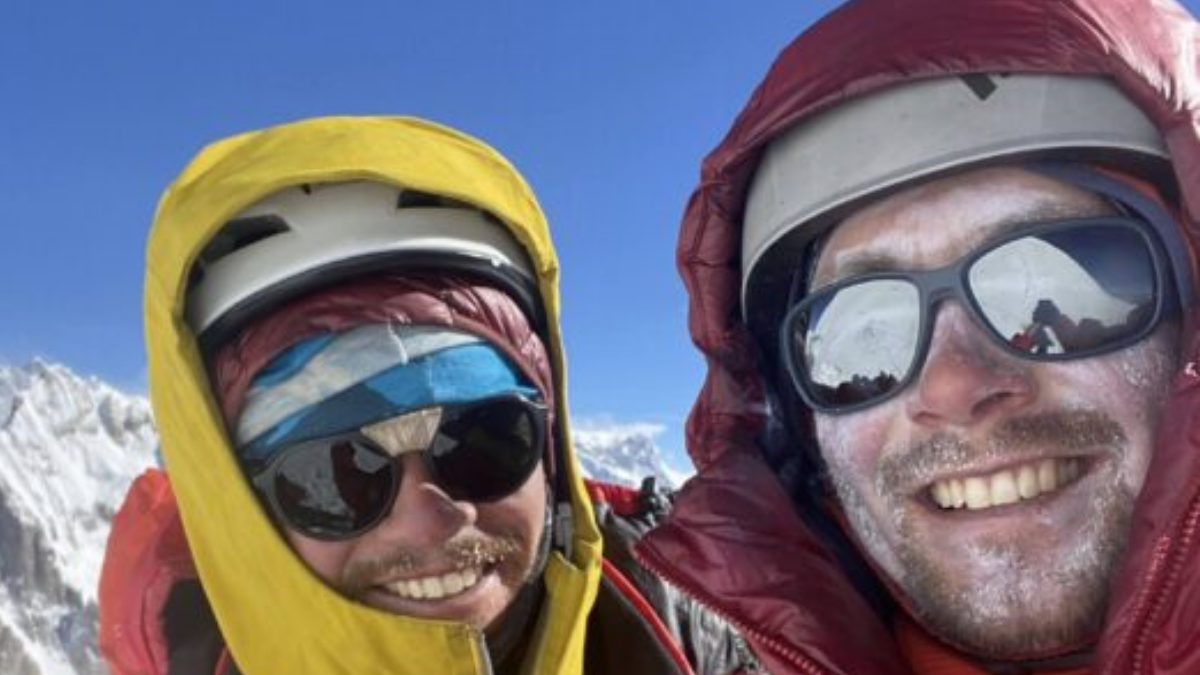

The ice was black and it did not forgive mistakes. James Price swung his axe and it skated off the surface with a dead, hollow sound, no purchase, nothing to trust.
Somewhere below him George Ponsonby stood in the dark with his headlamp beam cutting a small, tired circle into the slope, waiting for the rope to move.
They were seven days into a climb on a mountain that barely had a name, on a face nobody had ever climbed, with food running low and no way to call for help if either of them fell. Every pitch was sixty full metres, rope stretched to its end, over and over, because there was nowhere flat enough to stop
They did not know it yet, but this brutal, half-blind slog up bulletproof ice was about to become one of the four climbs chosen for the 2026 Piolets d’Or the award alpinists call the Oscars of mountaineering.
TWO CLIMBERS, ONE UNLIKELY PARTNERSHIP
James Price, 28, and George Ponsonby, 29, are young alpinists from Britain and Ireland. In October 2025 they climbed a new route up a peak called Aikache Chhok also known locally as Akbar Chhok a 6,673-metre summit buried in the Baltar Valley, deep in Pakistan’s Karakoram range near the Batura Muztagh.
Almost nobody had heard of it. Almost nobody had climbed it. The only previous ascent was in 1983, when an Italian team took the south ridge. Price and Ponsonby’s route went up the untouched northwest face a completely different, harder side of the mountain.
The climb took nine days, from 13 to 21 October. They went up roughly 3,000 metres of new ground, then came down the other side, across ground that had never been climbed either. Along the way the route earned a grade that tells its own story: M7 for the hardest mixed rock-and-ice climbing, A2+ for sections they had to aid their way up, and AI5 for sustained, unrelenting ice.
The route needed a name, and the one they gave it is deliberately ridiculous “Secrets, Shepherds, Sex and Serendipity.” It came from a joke Bollywood-style screenplay the pair invented at base camp, killing time while bad weather sat on the mountain and refused to move.
It is the kind of name that only makes sense once you know two exhausted men wrote it half out of boredom, half to keep from losing their minds.
FIFTEEN MINUTES THAT CHANGED EVERYTHING
James Price grew up in Horsham and Ardingly, in West Sussex, on the edge of the North and South Downs. His parents weren’t climbers they liked camping and hiking, and worried about him the way most parents would once the hiking turned into something steeper.
He got serious about climbing around eighteen, worked for a time as a healthcare assistant, and by 2020 had left that behind entirely to climb full time. He moved to the Alps and built a résumé most alpinists would call a career’s worth the Eiger, the Grandes Jorasses, a solo Matterhorn, all 82 Alpine 4,000-metre peaks.
📷 © YAG archive
But it was Pakistan’s Karakoram the Hunza and Batura region especially that pulled at him hardest. Aikache Chhok was his fifth expedition there.
It nearly cost him everything once already. In 2022, on a solo attempt to traverse a long, remote stretch of the Batura Wall, he was hit by a storm high on the ridge, turned back, and then had to self-rescue across ridge, glacier and roughly 70 kilometres of Karakoram terrain with severe frostbite.
He lost several toes. He went anyway, this time with an ankle tendon injury nagging him before the trip even started bad enough that he packed a ski boot as a backup in case he couldn’t wear a normal climbing boot. It improved enough that he never needed it.
George Ponsonby comes from a farm in Tipperary, Ireland, where the local “mountain” is really more of a gently sloping bog.
During the COVID lockdown he spent time there with his father, his grandmother, the family dogs, and he’s mentioned this fondly more than once a robin that used to visit the kitchen.
His climbing grew out of Irish traditional and sea-cliff routes, at venues like Fairhead, Owey Island and Ailladie, places he describes as some of the purest climbing there is, precisely because the mountains aren’t trying to kill you the way the Karakoram can.
Aikache Chhok was his first real trip to the Greater Ranges. He arrived for it straight from a summer of commercial salmon fishing in Alaska, working roughly six in the morning to half past eleven at night brutal hours, but nothing like training for a Karakoram wall. He showed up undertrained and performed like he wasn’t.
Young Alpinist Group
They found each other through the Young Alpinist Group, known as YAG a three-year mentorship programme founded by Tom Livingstone and backed by Alpine Club the the world’s first mountaineering club, founded in the UK in 1857, built specifically to take strong Alps climbers and turn them into climbers who can open new routes in the Greater Ranges. Price and Ponsonby were both in the same intake.
📷© YAG archive
The Pakistan trip itself came out of almost nothing. On a YAG winter trip to Scotland in January 2025, members were asked to pitch ideas for that year’s expedition. Price and Ponsonby spent about fifteen minutes brainstorming together. Ponsonby’s idea was somewhere in Tajikistan.
Price’s was vaguer just “a little-visited valley in Pakistan.” The group voted, and Price’s idea won.
At that point, the two of them had climbed together exactly once a single winter day on the Grandes Jorasses in the French Alps. It was enough to tell them their instincts matched. Nine months later, that one day in the Alps was the entire track record they were carrying up a Karakoram wall.
THE KARAKORAM FLOP
They didn’t have a real plan for a route. From their tent at base camp, around 3,400 metres in the Baltar Valley, they looked up and picked a long northwest ridge and buttress line they liked the look of, with almost no photos, no reports, nothing to go on but what they could see. On 13 October they left with food for about five days and fuel for seven an alpine-style bet that the mountain wouldn’t take longer than that to let them through.
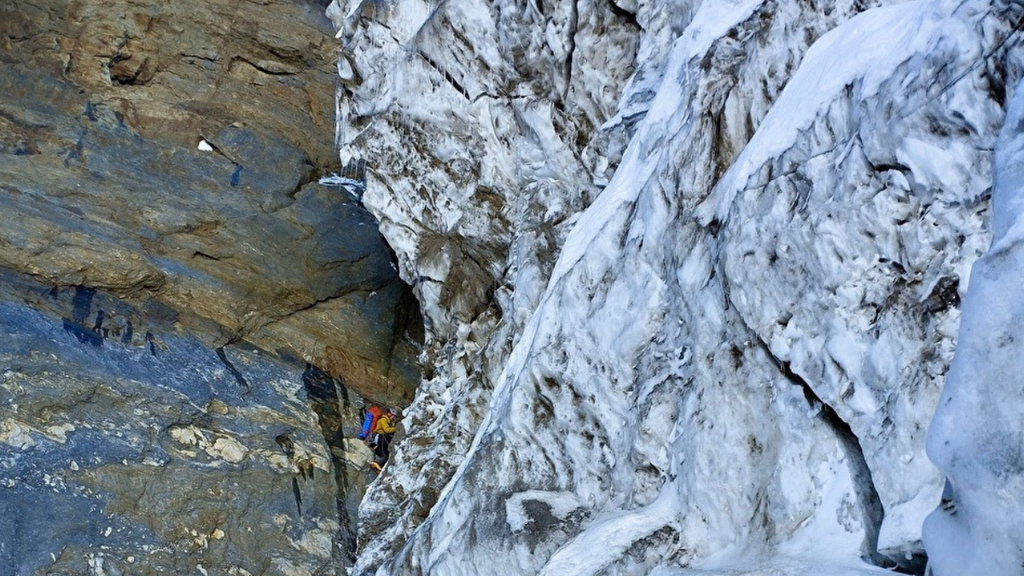
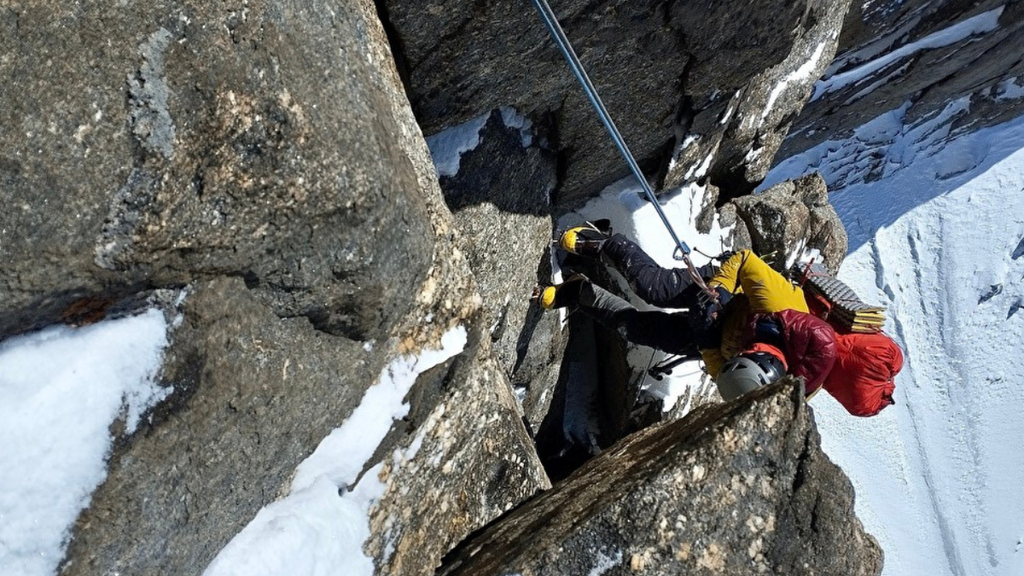
Day one went well. They moved fast up a gully system into mixed ground, up to M5 and M6, gaining the ridge with real optimism. Day two crushed that optimism completely. They managed just three pitches all day, fighting an overhanging, crumbling crack that forced them into desperate mixed and aid climbing up to M7 and A2+ rock that broke apart in their hands as they climbed it.
The days after blurred into a grinding, improvised survival exercise. They bivied wherever the mountain allowed, once tucked under a rock step for shelter.
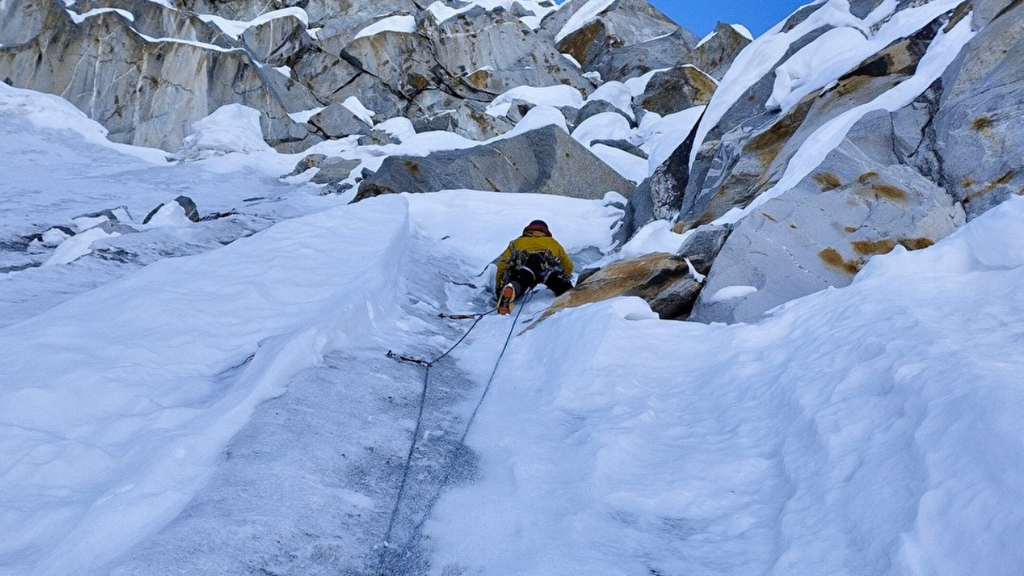
They spent real time and energy on a traverse that turned out to be a dead end, and had to backtrack and find another way.
Then came the day that defined the whole climb pitch after pitch of sustained, glassy AI5 ice, so hard and featureless that Price and Ponsonby invented their own technique for surviving it, half-joking, half-serious they called it the “Karakoram flop,” a way of collapsing bodyweight onto the slabby black ice just to keep moving without shattering their calves.
Full sixty-metre pitches, rope stretched to its limit, some of them climbed entirely by headlamp because there was no daylight left to finish in. Gear broke. Fatigue piled on top of fatigue.
Near the top, a whiteout swallowed the mountain. Deep snow slowed them to a crawl on what they thought was the final ridge to the summit until they realised the point marked on their map wasn’t the actual top at all.
They bivied just short of the true summit, fixed one more pitch that evening to save time, and the next morning shared their last energy bar between them before pushing for the top. They reached the true summit on roughly day eight. There was no time to enjoy it. The moment they stood on it, their attention turned entirely to getting down alive.
THE SUMMIT WAS ONLY HALF THE BATTLE
The descent took two more days and was, by their own account, more dangerous than the climb up. They were dropping down the southwest face completely unscouted, unclimbed ground on the far side of the mountain from where they’d started.
It meant rappel after rappel off makeshift anchors in rock and ice, crossing glaciers riddled with hidden crevasses, threading past seracs that could shift with no warning, picking their way down a final rock rib on legs that had nothing left.
They made it back to base camp exhausted but unhurt no frostbite this time. Ponsonby had dropped nearly twenty pounds off his frame, down from around 180 to 160 pounds. Both men were empty in a way that takes weeks to refill.
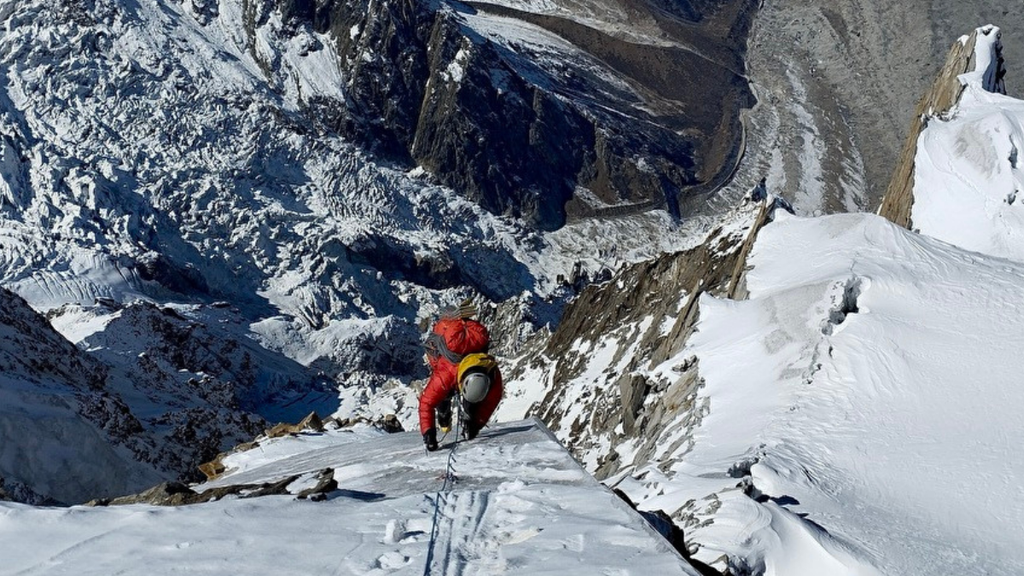
What makes this climb stand out in alpinism isn’t just that it was hard it’s how they did it. Price and Ponsonby climbed in what’s called alpine style no fixed ropes strung up the mountain in advance, no team of porters carrying their loads, no support crew waiting in reserve, no rescue realistically available if things went wrong high on the face. They carried what they needed on their backs and committed to the mountain as two people, alone.
This is the opposite of siege-style expeditions, where large teams fix rope from bottom to top over weeks, stock camps with supplies, and reduce the objective danger by throwing resources at it.
Alpine style strips all of that away. It’s faster, lighter, and far more exposed every decision made without a safety net, every mistake potentially unrecoverable. That’s precisely why it’s held up as the purest form of the sport: nothing between the climbers and the mountain except their own judgment and whatever they can carry.
THE SHEPHERDS WHO WATCHED FROM BELOW
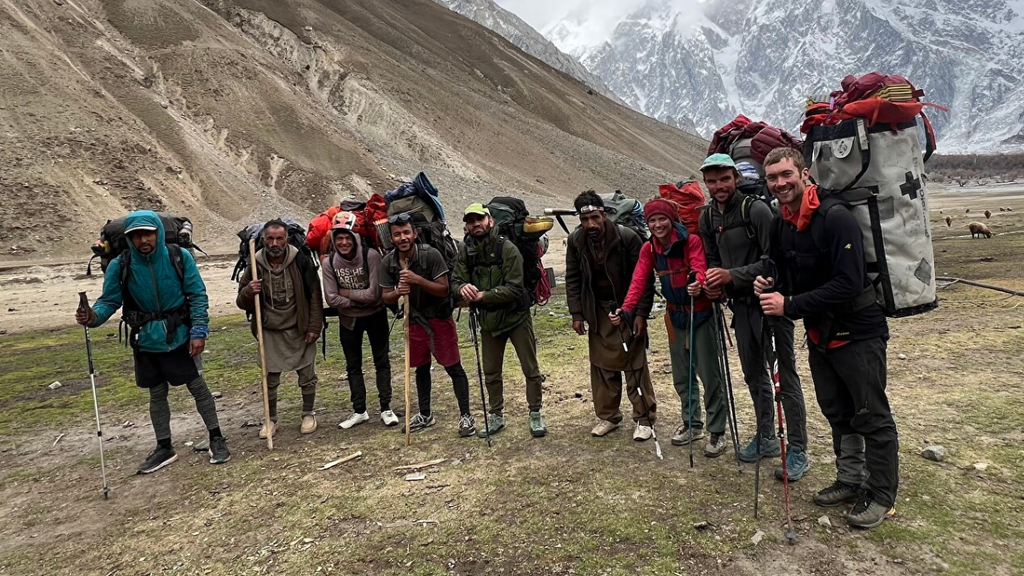
Against that danger sat a much warmer thread running through the whole trip the local shepherds of the Baltar Valley, who fed the pair chai, gave them a hut to shelter in, and quite literally kept watch over them, following their progress on the mountain through binoculars and flashing headlamps back at them from the valley floor as a kind of long-distance encouragement.
It’s a detail that says as much about the climb as any grade does: two young men risking everything on a wall with no name, and a community of strangers below who cared whether they came home.
WHEN THE MOUNTAINING WORLD TOOK NOTICE
The Piolets d’Or the “Golden Ice Axes” are widely considered the top honour in mountaineering, often called the sport’s Oscars. Each year, climbs from around the world are gathered into a “big list” of roughly fifty notable ascents.
From that list, an international jury of experienced alpinists picks a small handful, usually three to five, for the actual award. Just making the big list is a real mark of respect within the climbing world; being chosen for the award itself is a career milestone.
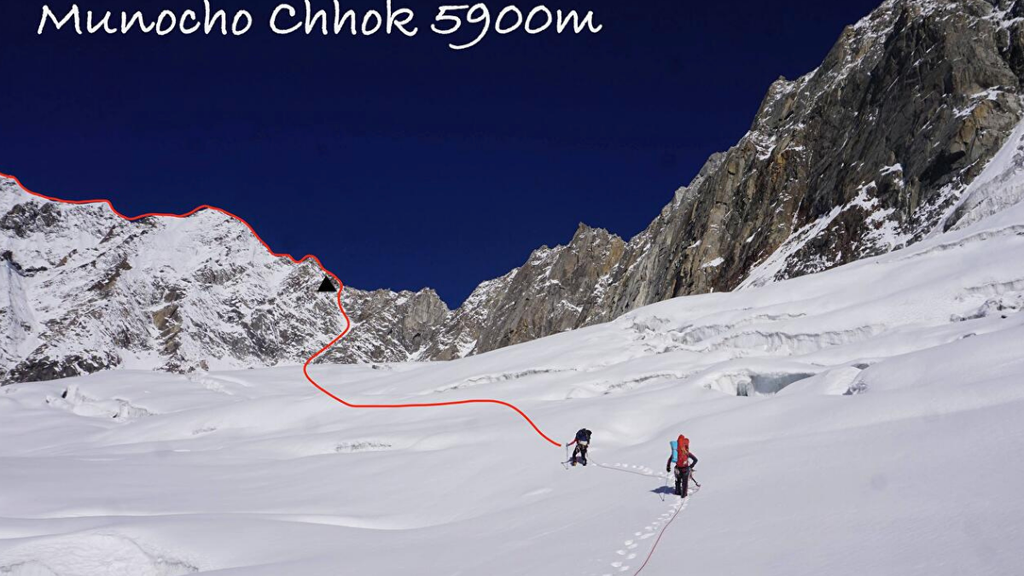
Price and Ponsonby’s climb was one of four selected for the 2026 Piolets d’Or, honouring the best ascents of 2025. In explaining the choice, the jury pointed to a few things in particular this was a long, deeply committing route in a remote, little-known corner of the Karakoram, climbed by two young, spirited alpinists.
They showed real persistence through serious technical difficulty the hard mixed climbing, the aid sections, the sustained ice in a setting where rescue was, for all practical purposes, not an option. And because the descent down unclimbed, challenging terrain on the far side of the mountain was just as demanding as the way up, the jury noted that the real test of the climb didn’t end at the summit it continued all the way back to base camp.
Alpine Club president Duncan Sperry framed it as part of a longer tradition, noting that AC members have picked up Piolets d’Or recognition for more than three decades, and that Price and Ponsonby’s ascent extends that legacy proof, in his words, that real mountaineering adventure on genuinely new ground is still out there to be found.
THE LEGACY OF A ROUTE WITH NO NAME
For a programme built specifically to turn capable Alps climbers into Greater Ranges climbers, it’s hard to imagine a stronger result than this. Price and Ponsonby’s climb has been held up as validation of everything the Young Alpinist Group set out to do take promising young climbers, give them a structured path, and see what happens when they’re finally handed a mountain of their own.
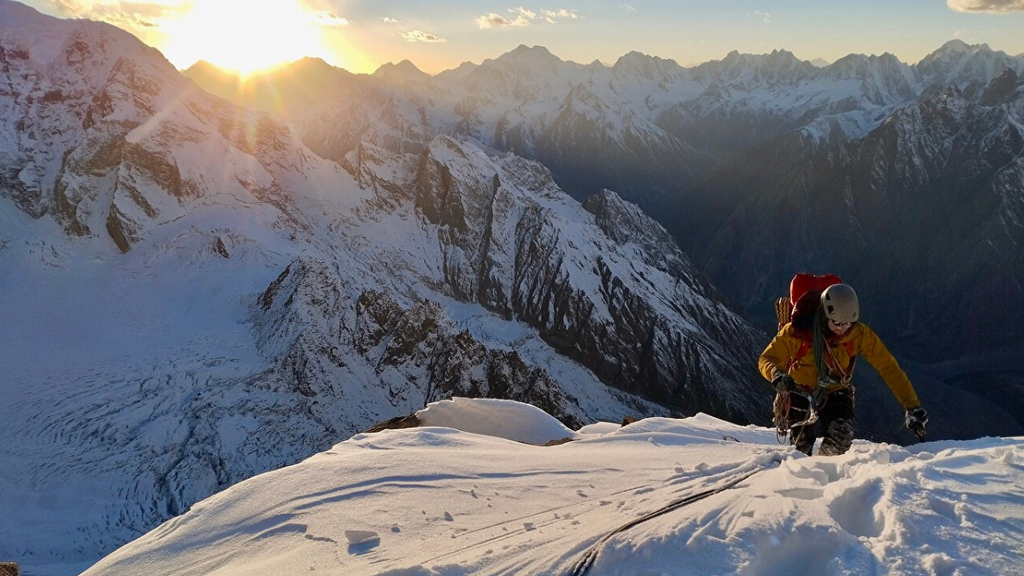
The pair were due to share the story properly at the Royal Geographical Society in London in March 2026, in front of an audience that understands exactly what nine days on an unnamed Karakoram face actually costs.
Both men have talked since about going back to ordinary life ordinary work, ordinary routines while the climb settles into memory.
Ponsonby has his own way of putting what the whole thing felt like, and it might be the truest line in the entire story it was “Type 2 fun.” Miserable enough in the moment that he’d have given up his life savings just to be off the mountain and yet, looking back, exactly the kind of experience that makes all the climbing before it feel like it was leading somewhere.
