
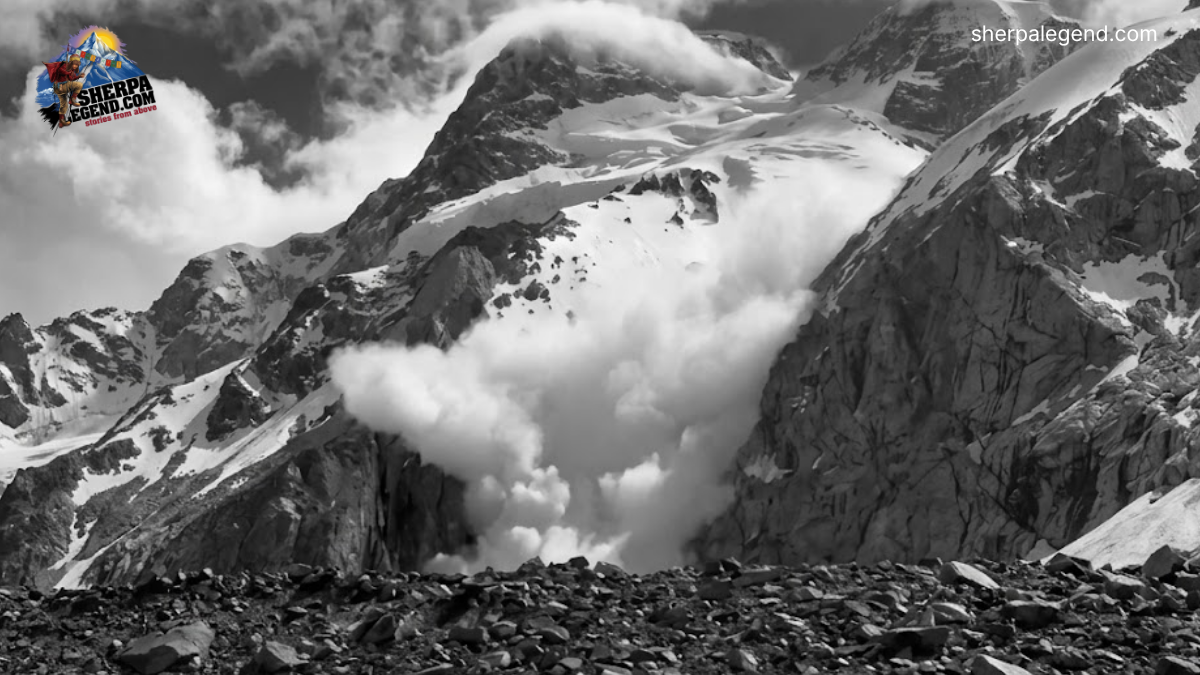

Recovery operations on Pakistan’s Broad Peak, the world’s 12th-highest mountain at 8,051 metres, entered their sixth day on Tuesday. Rescue teams are preparing for another attempt to bring down the climbers still stranded high on the mountain after last week’s avalanche.
According to the Alpine Club of Pakistan (ACP), helicopters are expected to work alongside ground teams on Tuesday to try to recover the remaining bodies, weather and terrain allowing. More rescuers and equipment are due to leave for the mountain early in the morning.
Three climbers are still on the mountain. Two more people, Pakistani climber Sohail Sakhi and American climber Mallory Geis, remain missing.
Recovery Progress So Far
The ACP has released a day-by-day account of the recovery so far.
On Friday, two bodies and the partial remains of a third climber were brought down. On Saturday, the body of Gyalu Sherpa was recovered. On Sunday, four climbers were formally identified: Nirmal “Nims” Purja, Wang Zhong, Nima Sherpa, and Kili Pemba Sherpa.
So far, six climbers have been recovered in total.
At the moment, two of the recovered bodies have reached Broad Peak Base Camp. Three others are sitting at around 5,000 metres, waiting to be brought further down. One more body is in a spot rescuers cannot yet reach.
Three climbers remain on the mountain: Nirmal Purja, Wang Zhong, and Nawang Thindu Sherpa.
Fresh Avalanche Delays Recovery
Just as teams were making progress, a fresh avalanche and worsening slope conditions forced them to stop.
The bodies of Nirmal Purja and Wang Zhong are still stuck above Base Camp because rescuers could not safely lower them down an extremely steep section of the mountain. “The terrain is very difficult, making it impossible to bring them down safely,” Khan said.
ACP President Irfan Arshad Khan
Veteran Nepali climber Mingma Gyalje Sherpa, known as Mingma G, confirmed that another avalanche swept through the area, making it too dangerous to continue. A separate body, believed to be that of Nawang Thindu Sherpa, is stuck on a narrow ridge that rescuers consider highly hazardous to approach.
This new avalanche has understandably raised hard questions about how a mountain already known for danger could see a second slide strike a recovery operation.
But those questions are for later. Right now, families of the missing and the dead are waiting for their loved ones to come home, and every rescuer on the ground understands that finishing the recovery safely has to come first. A full investigation into what happened, and why, can and should follow once the mountain allows the remaining climbers to be brought down. Rushing to answer “why” before the recovery is complete would only pull attention and resources away from the people still up there.
Calls For Long-line Helicopter Rescue
With ground teams repeatedly forced to cross avalanche-prone terrain, Nepali rescuers have renewed their calls for a long-line helicopter recovery.
In this kind of operation, a helicopter lowers a long cable and lifts a body directly off the mountain, without rescuers needing to walk across dangerous slopes themselves. Supporters of this method argue it would cut down the risk to the living rescuers by a wide margin.
The obstacle is bureaucratic as much as technical. Any helicopter operation in Pakistan’s Karakoram range needs approval from the Pakistani military, since the region sits close to sensitive border areas. That means a rescue method that could be launched almost immediately in some countries first has to clear a chain of official permissions in Pakistan.
Mingma David Sherpa, a Nepali lawmaker and co-owner of Elite Expeditions, is currently in Pakistan working directly with government officials and military authorities to try to secure that permission.
Rescuers had hoped to lower four bodies down to a safer, flatter area on the Concordia side of the mountain. In the end, they only managed to bring down Kili Pemba Sherpa and Nima Sherpa before conditions worsened and the mission had to be paused.
How We Got Here
Broad Peak sits close to K2, separated only by the Godwin-Austen Glacier, with the two mountains’ base camps not far apart. Follow that glacier downstream and it meets the Baltoro Glacier at Concordia, often called the “Throne Room of the Gods” for its scenery.
It is also one of the most remote and rugged mountain regions on Earth. Broad Peak was first climbed in 1957 by an Austrian expedition, and despite being lower than K2, it has a long-standing reputation for avalanches, rockfall, and a dangerously long summit ridge.
This year’s season on Broad Peak had fewer expeditions than usual, with most climbers focused on Broad Peak alone rather than using it to acclimatise for K2. Rope-fixing teams reached the summit on July 18, with more climbers following on July 19.
On July 21, Nims Purja summited Gasherbrum II without supplemental oxygen, leaving only Broad Peak and Cho Oyu for him to complete all fourteen 8,000-metre peaks twice without oxygen. He made what appears to have been a last-minute call to head to Broad Peak.
Snow began falling on July 22, though how heavy it actually was is still unclear. On July 25, climbers Klein and Overton left Broad Peak Base Camp, deciding conditions had become unsafe. Around the same time, Nims and his team arrived and began preparing for their own summit attempt.
On July 29, the ten climbers still on the mountain began their summit push, reaching Camp II that day. Early on July 30, GPS trackers showed the group at 6,166 metres at 5:33 a.m., roughly 6,430 metres by 7:00 a.m., and about 6,600 metres just before 9:00 a.m. They were moving through a basin between Camp II and Camp III known to be an avalanche terrain trap. Their final communication came around 9:00 a.m., the point believed to mark when the avalanche struck.
One of the biggest unanswered questions from that day is why the avalanche was reportedly not officially registered until around 8:00 or 9:00 p.m. that night, an 11-hour gap with no clear explanation so far.
Search teams organised overnight and began work on July 31. By that afternoon, three bodies had been located and drone searches had spotted more higher on the mountain. K2 expeditions were called off, with climbers descending to help with the Broad Peak rescue instead.
On August 1, ground teams reached an area where five victims were found close together and began the difficult process of lowering them toward Camp I. Elite Expeditions confirmed Nims Purja’s death that same day. On August 2, teams focused almost entirely on bringing bodies down to Camp I, with further attempts uncertain given how dangerous the work had become. By August 3, teams were waiting on the possibility of a long-line helicopter operation, which is where things stand today.
Questions That Remain
Several questions from that day on the mountain are still without answers.
Why did the team continue climbing upward, and did they believe conditions were safe enough to proceed? Why were ten climbers exposed to the avalanche path at the same time? Why did roughly eleven hours pass before the avalanche was officially reported? And there is still debate over movement recorded on Nims’ GPS tracker after the avalanche struck — whether it reflected real movement or was simply a tracking error.
Those questions will likely be examined and debated within the climbing community for years to come. In time, investigations and firsthand accounts may provide a clearer picture of what happened.
For now, however, the priority lies elsewhere.
Families in Nepal, Pakistan, Oman, China, and the United States are still waiting for their loved ones to come home. Rescue teams continue to risk their own lives in dangerous, avalanche-prone terrain to recover those who remain on the mountain.
Until every possible recovery effort has been made, that should remain the focus—not speculation, but bringing the climbers home with the dignity they deserve.
For those of us reading about this from far away, it’s worth remembering that decisions made at 8,000 metres are not made under the same conditions as decisions made at home. Altitude, lack of oxygen, exhaustion, summit fever, group dynamics, and the unpredictability of mountains all combine to make choices far more complicated than they look in hindsight.
The question “were conditions safe?” rarely has a simple yes-or-no answer on a mountain like Broad Peak. The decisions made between Camp II and Camp III will likely be picked apart for years. At this stage, much of the discussion is still speculation, and speculation alone often causes more pain than it resolves. Sometimes, acceptance has to come first.
Can This Ever Be Prevented?
Many in the climbing community see tragedies like this as an unavoidable part of mountaineering, and that view deserves to be heard. Climbing the world’s highest peaks carries risk that can never be fully removed.
At the same time, it is still worth trying to make the sport safer wherever possible. Lower risk means more people get to climb, climbers get longer careers, fewer families lose loved ones, and fewer mountain workers die doing their jobs. Most people in the mountaineering community share that goal, even if how to get there remains an open question.
Recovery operations continue on Broad Peak. As this phase of the story slows down, coverage should also make room to respect the families waiting for answers, the rescuers risking their own safety, and the climbers who lost their lives — rather than chasing constant updates for their own sake.
Further updates will follow as the recovery progresses.
This review is based on everything that is currently known about the Broad Peak avalanche and recovery operation. The information has been compiled from reporting by ExplorersWeb, Everest Chronicle, and National Geographic, as well as firsthand accounts from climbers who were on Broad Peak before the July 29 summit push, climbers on nearby K2 at the time of the accident, members of the rescue and recovery teams, and official updates issued by the Alpine Club of Pakistan (ACP). Together, these sources provide the most complete picture currently available, although some details may continue to evolve as the recovery operation progresses.
