
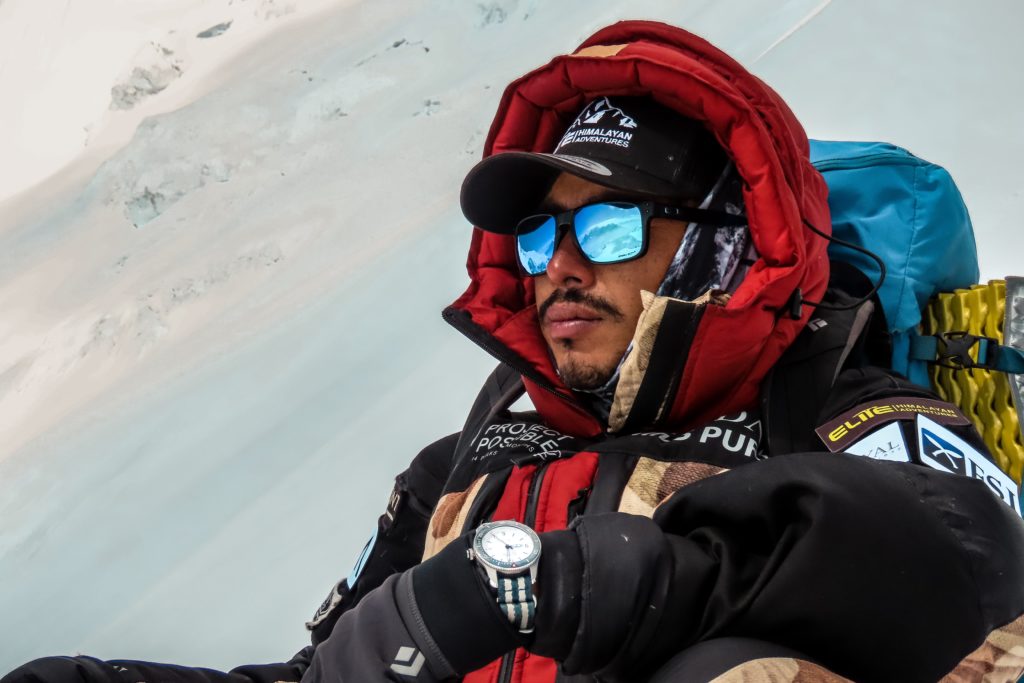

A ten-member international team, including record-breaking mountaineer Nirmal “Nims” Purja, goes silent after an avalanche strikes one of the world’s deadliest 8,000-metre peaks
For much of the world, Nirmal “Nims” Purja is the man who does the impossible. He climbed all fourteen of the planet’s 8,000-metre mountains in under seven months, a feat that once seemed to take mountaineers a lifetime. He served in Britain’s most elite special forces unit before that. He has walked away from storms, oxygen failures, and near-misses that ended other careers. On Thursday, that record of survival was tested on a mountain few outside the climbing world have heard of: Broad Peak, on the Pakistan-China border, deep in the Karakoram range.
As of Friday, July 31, Purja and nine other climbers are missing. Contact was lost after an avalanche tore across the upper slopes of the mountain on Thursday, July 30. No one has heard from any of them since.
What Happened, and When
The avalanche struck at high altitude on Broad Peak, the world’s twelfth-highest mountain at 8,047 metres (about 26,400 feet). According to the Alpine Club of Pakistan (ACP), the slide hit around midday on Thursday, though GPS tracking data reviewed by mountaineering outlets points to a more precise window: roughly 9:20 to 9:30 in the morning, Pakistan time.
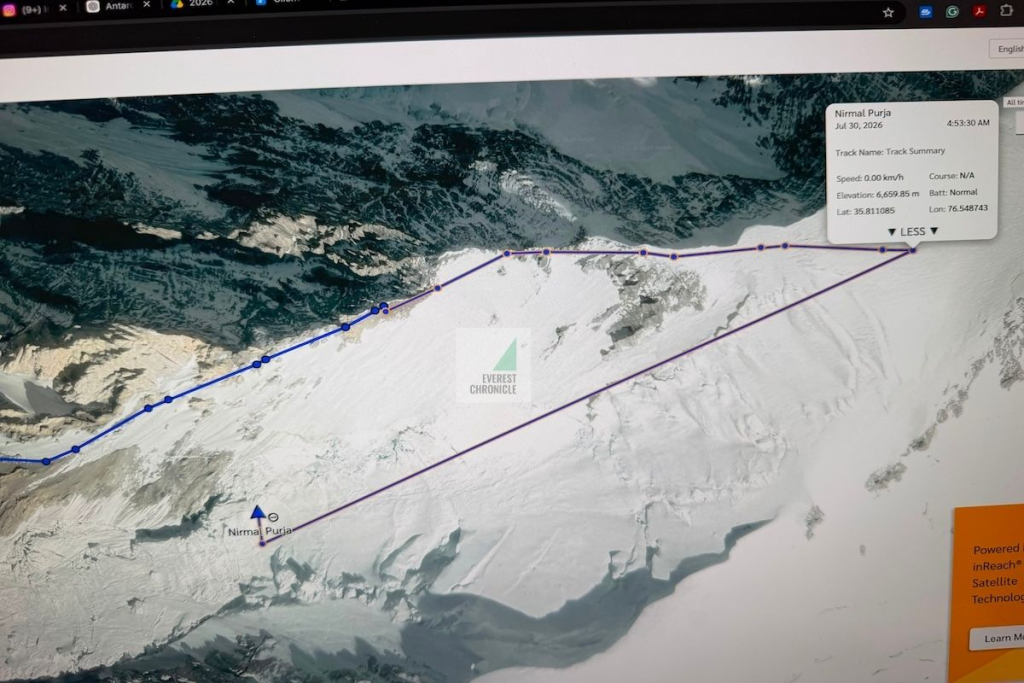
At that moment, the climbers were between Camp 2 and Camp 3, at an altitude of approximately 6,500 to 6,660 metres. The team had reached Camp 2 the day before, Wednesday, and were pushing higher when the mountain gave way beneath them.
Karrar Haidri, senior vice-president of the Alpine Club of Pakistan, confirmed the loss of contact directly. “The entire team has reportedly been out of communication since the avalanche,” he told Everest Chronicle.
The Last Signals
There were no final radio calls. No last messages have been made public. What investigators and journalists have instead is tracker data — the small electronic breadcrumbs that satellite GPS devices leave behind, and which have become the only real evidence of what happened on the mountain.
The data is unsettling. Purja’s own tracker shows him climbing normally, then suddenly losing several hundred metres of altitude in a matter of minutes — a straight-line drop consistent with being swept downhill by moving snow and ice. One analysis of the timestamps found he was roughly 800 metres higher at 8:53 in the morning than he was at 9:33, a gap of just forty minutes.
Other climbers’ trackers tell a similar story, though the scale varies sharply from person to person. According to tracker data shared by Pakistani mountaineer Samson Sharaf and reported by Climbing magazine, American climber Mallory Geis dropped 543 metres. Omani mountaineer Nadhira Al Harthy’s tracker showed a fall of 1,651 metres — more than a kilometre.
None of this data has been officially verified by rescue authorities. High-altitude GPS devices can lag, glitch, or keep transmitting after impact if they land somewhere with a clear signal. But the pattern across multiple climbers’ devices, all showing a sudden, severe loss of elevation at almost the same time, points strongly in one direction: they were caught in the avalanche together.
Adding to the difficulty of the response, word of the disaster did not reach base camp and the outside world until around 10 p.m. that night — nearly thirteen hours after the slide. By then, the daylight window for an immediate search had already closed.
Who Is Missing
The group numbers ten climbers in total, drawn from several countries and expeditions that had converged on Broad Peak during this year’s Karakoram climbing season.
- Nirmal “Nims” Purja — the expedition’s most well-known member, leading a team for his company, Elite Exped.
- Four other Nepali climbers, believed to be guides working alongside Purja. Their full identities had not been officially released as of Friday.
- Sohail Sakhi — a Pakistani climber and guide from Hunza, experienced across Pakistan’s 8,000-metre peaks.
- Nadhira Al Harthy — an Omani mountaineer known as the first Omani woman to climb Everest.
- Mallory Geis — an American climber from San Antonio, Texas, on her first attempt at an 8,000-metre peak, climbing as Sakhi’s client.
- Wang Zhong — a Chinese climber reportedly working toward his own goal of climbing all fourteen 8,000-metre peaks.
- One additional foreign climber, whose name and nationality had not been released in early reports.
Other teams were also active on the mountain that day, including groups tied to Imagine Nepal and Seven Summit Treks, but it is this ten-person group that was caught by the avalanche and remains out of contact.
Why Purja Was on Broad Peak
Purja’s presence on the mountain was, by most accounts, a late addition to his season. Just nine days earlier, on July 21, he had summited Gasherbrum II without supplemental oxygen — his 57th ascent of an 8,000-metre peak in a remarkable career. That climb left him with only one mountain, Cho Oyu, remaining to complete what he calls his “Hat-Trick Project”: climbing all fourteen of the world’s 8,000-metre giants three times over, while also completing the Seven Summits three times.
Purja, born in Nepal, later became a British citizen after serving in the British Army’s Special Boat Service, one of the UK’s most demanding special forces units. He has said the Hat-Trick Project is intended to raise more than £1 million for the Nimsdai Foundation, which funds humanitarian and education work in Nepal. One of the foundation’s recent projects, the Lobuche Porter House, opened in the Everest region in May, offering shelter to porters working on trekking and climbing expeditions.
The Search Effort
The Alpine Club of Pakistan says it is coordinating with government authorities and military rescue agencies to mount an emergency response. “Every possible effort is being made to ensure that helicopter support and all available rescue resources are mobilized at the earliest opportunity, subject to weather and operational conditions,” the club said in a statement.
Major General Irfan Arshad, president of the Alpine Club of Pakistan, said the organisation stood with the climbers’ families and the wider mountaineering community as the search got under way.
Mingma David Sherpa, co-founder of Elite Exped, confirmed the incident and said a helicopter was expected to reach the area early Friday morning, weather permitting. Poor weather and difficult operating conditions at altitude had already delayed the start of the search by the time this story was published.
As of Friday, July 31, there has been no confirmed contact with any of the ten climbers, and no confirmation of casualties or survivors. The Alpine Club of Pakistan describes the situation as ongoing.
A Dangerous Season on a Dangerous Peak
Broad Peak sits in the Karakoram range near K2, on the border between Pakistan and China. Avalanches are among its most persistent hazards, a risk shared by its towering neighbor. The current climbing season in the Karakoram is at its peak, with multiple expeditions simultaneously attempting K2, Gasherbrum I, and Broad Peak. Nepali rope-fixing teams have been positioned at Camp II on several of these peaks this week, and two Nepali-led teams reached the summit of Gasherbrum II on the same day the avalanche struck Broad Peak — a reminder of how much mountaineering activity was concentrated in the region when disaster hit.
What Comes Next
This remains a developing story. No official confirmation of survivors, casualties, or the climbers’ exact fate has been issued by rescue authorities as of this writing. Search helicopters were expected to reach the search zone as weather allowed, and updates are expected from the Alpine Club of Pakistan, Elite Exped, and international mountaineering outlets as the operation continues.
Sherpa Legend will continue to follow this story and update it as verified information becomes available.
Reporting based on statements from the Alpine Club of Pakistan, Elite Exped, and coverage from ExplorersWeb, CNN, BBC, Outside, and Climbing magazine.
