
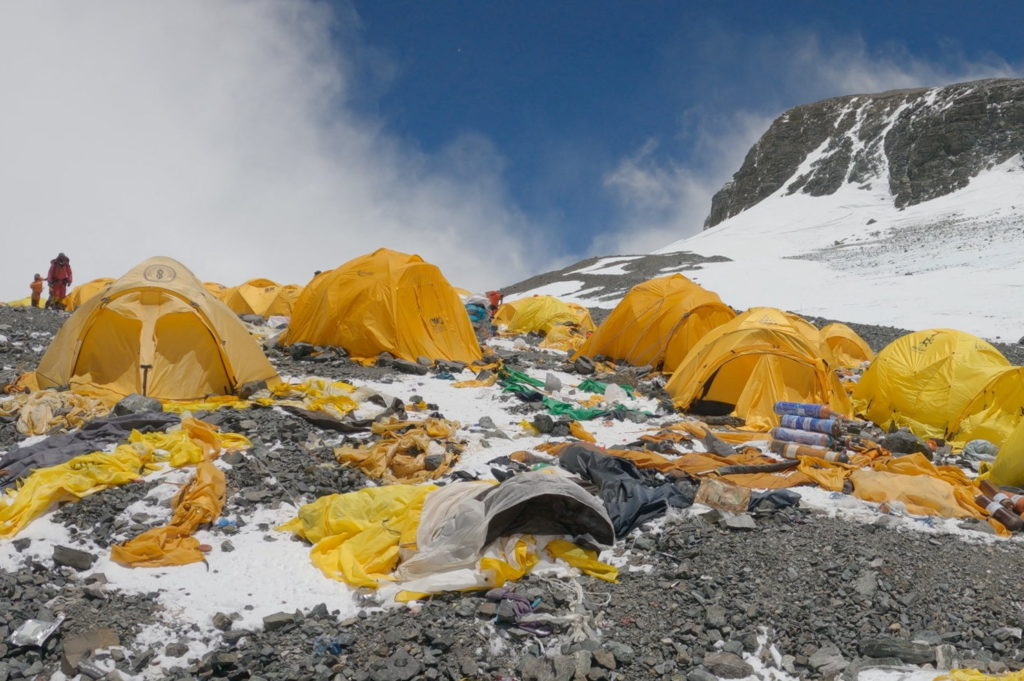

From oxygen bottles to human waste, the world’s highest peak is bearing the weight of our ambition and our carelessness. With record crowds, a melting glacier, and decades of abandoned gear, the question is no longer just about reaching the summit. It is about whether the mountain will survive us.
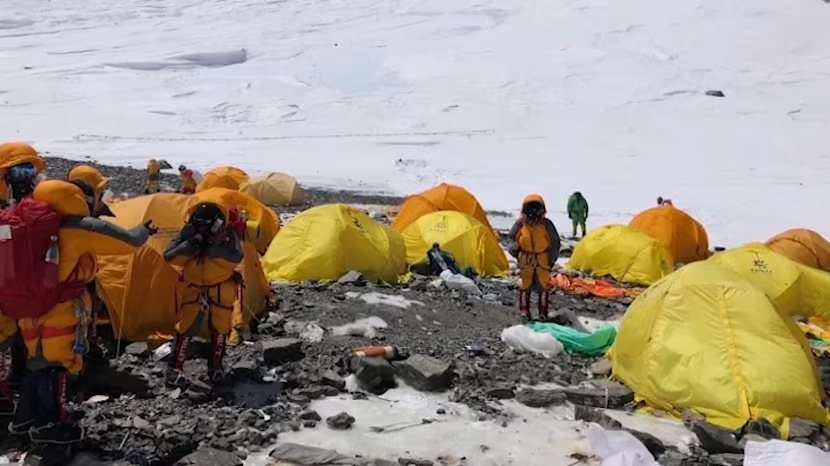
At 8,000 metres above sea level, in the thin, brutal air of the Death Zone, something disturbing catches the eye of every climber who passes through Camp 4 on Mount Everest. It is not a fellow adventurer. It is not a view. It is garbage heaps of it. Shredded tents, tangled ropes, empty oxygen cylinders, discarded food wrappers, and gear left behind by thousands of climbers over many decades, frozen and re-frozen into the mountain’s body, year after year.
The world’s tallest peak known as Sagarmatha in Nepali and Chomolungma in Tibetan, both names carrying deep spiritual meaning has long been called the “world’s highest garbage dump.” For many who live in its shadow, that phrase is not a metaphor. It is a painful truth.
The Numbers Are Staggering
The scale of the problem is hard to imagine until you see the data. Researchers and cleanup teams estimate that somewhere between 30 and 50 metric tonnes of accumulated waste remain on the mountain with 40 to 50 tonnes concentrated at the South Col, Camp 4, alone. That is the weight of several large trucks, frozen into one of the most remote and dangerous places on earth.
Peak Promotion / AP
Every climber who attempts Everest generates roughly 8 to 12 kilograms of waste during their expedition. In a single busy season, Everest Base Camp alone produces 40 to 50 tonnes of waste. Expand that to the wider Everest region, including trekkers, support staff, and high-altitude porters, and the annual total reaches 200 to 250 tonnes. On peak days, more than 4,000 kilograms of solid waste can be generated in just 24 hours.
And the crowds are not getting smaller. In the spring season of 2026, Nepal issued 492 climbing permits a record number resulting in more than 950 successful summits. Every permit is a person. Every person carries waste. Not all of it comes back down.
What Gets Left Behind and Why
Ask any experienced climber why people abandon gear on Everest, and the answer comes quickly survival. Above 8,000 metres, the human body is shutting down. The brain receives less oxygen than it needs to function. Muscles burn through their reserves. Judgement blurs. In that state, carrying an extra kilogram of trash down a sheer face of ice and rock is not a moral question it is a physical impossibility.
Veteran climber Mingma Gyalje Sherpa, widely known as Mingma G, has spoken plainly about conditions on the mountain.
“Everest is becoming increasingly risky,” he has warned and not only because of the trash. He has watched the mountain change dramatically over the past 15 years, in ways that go far beyond litter.
“When I first went through the Khumbu Icefall in 2009, it used to take us 6 to 8 hours to reach Camp 1,” he said. “We had to climb large ice sections just to reach the point where we put on our crampons. Now, in just 20 to 30 minutes, we reach the crampon point without climbing any ice sections.”
The Khumbu Icefall the most dangerous section of the classic South Col route is melting so fast that some of Mingma G’s Sherpa colleagues now reach Camp 1 in as little as two to two and a half hours. That sounds like good news. It is not. Less ice means more exposed rock, more unstable terrain, and more unpredictable movement in the glacier. The trash buried under decades of ice and snow is now coming back to the surface, and it will keep coming.
Climate Change Is Making It Worse
Glaciologists have documented alarming losses in the Himalayan ice. The South Col Glacier has thinned by more than 54 metres over the past 25 years. The Khumbu Glacier, which forms the floor of Everest Base Camp, is retreating and thinning so rapidly that authorities are now studying whether the base camp needs to be relocated entirely.
Mingma G has described what he sees with urgency. From mid-May, he said, water flows everywhere through the Khumbu Icefall, turning entire sections into rivers.
“Water melts ice faster than the sun does,” he explained. “With water flowing everywhere in the Khumbu Icefall, the whole icefall will melt in less than 5 to 8 years.” He added that this year, water was flowing right below Camp 3 on the Lhotse Face a section of the route that should be solid ice. “If there is no ice or very little ice on the Lhotse Face,” he warned, “the accident rate from rockfall will increase dramatically.”
The implications for the mountain’s future are grim. Ice that took thousands of years to accumulate is disappearing within decades. As it melts, it exposes trash buried long ago oxygen bottles from expeditions in the 1970s and 1980s, tents from the 1990s, and in some cases the bodies of climbers who died on the mountain and were slowly engulfed by snow. Climate change is, in effect, exhuming Everest’s history and it is not a pretty sight.
The Toilet Problem Nobody Talks About
One of the least discussed aspects of Everest’s waste crisis is human excrement. Thousands of climbers have used the mountain as a toilet for decades. At high altitude, waste does not decompose the way it does at lower elevations. Instead, it freezes, accumulates, and as the glacier melts works its way into meltwater streams that communities in the Khumbu Valley depend on for drinking water.
Microplastics, shed from the synthetic fabrics and gear that modern climbers wear, have been detected in ice samples at altitudes above 8,400 metres. The mountain is not just collecting our rubbish. It is absorbing us.
Cleanup Efforts Real Progress, Not Enough
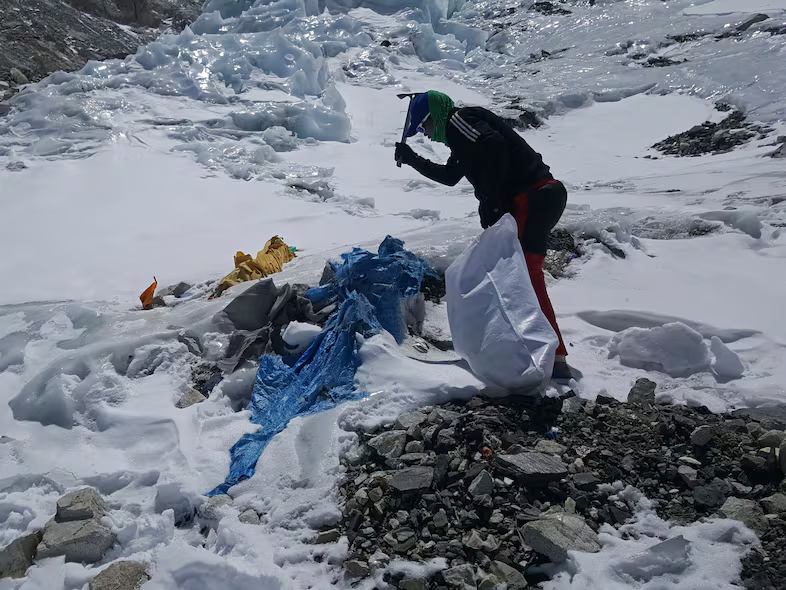
Nepal has not ignored the problem. Over the past decade, cleanup campaigns have removed significant quantities of waste from the mountain. In 2024 alone, roughly 11 tonnes were removed from high camps, in addition to broader regional efforts that collected approximately 85 tonnes across the wider Everest area. In 2023, the Nepal Army and partner organisations removed 35 tonnes of waste from Everest and other Himalayan peaks combined.
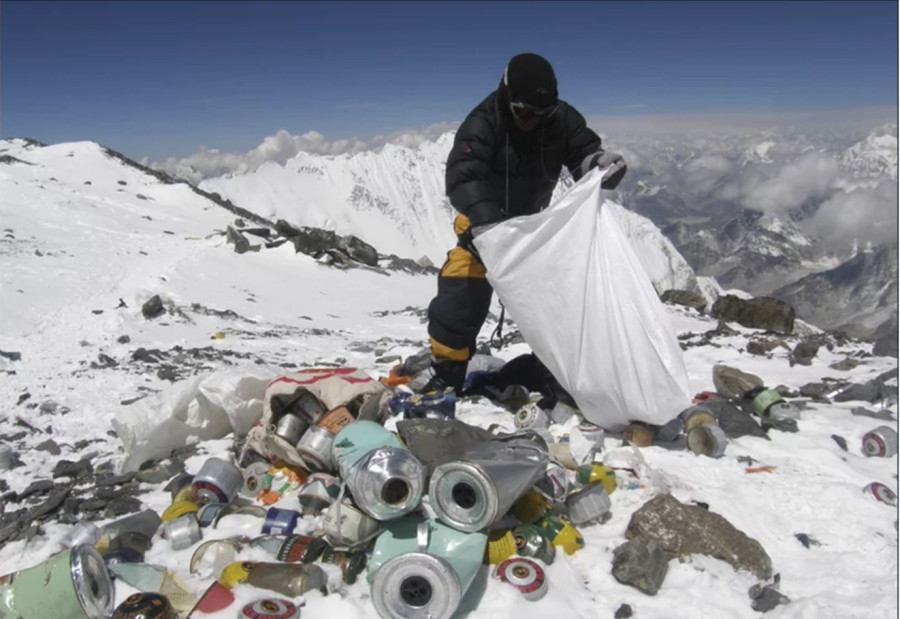
The Sagarmatha Pollution Control Committee (SPCC), along with Sherpa guides, military personnel, and international volunteers, leads much of this work. In 2025, drones capable of carrying up to 15 kilograms per flight were tested for high-altitude waste hauls a promising technology, though still in its early stages.
Nepal has also revised its regulations. A refundable garbage deposit of $4,000 requiring climbers to bring back at least 8 kilograms of waste had been in place since 2014. Critics, however, found it easy to game and largely ineffective. Under a new five-year plan covering 2025 to 2029, Nepal is replacing the deposit with a non-refundable conservation fee and introducing new collection points above Camp 2, mountain rangers to monitor compliance, a rope reclamation programme, and capacity limits on the number of climbers allowed per season. Authorities are also studying the possible relocation of Everest Base Camp.
“Progress exists,” as one assessment of the situation noted but record climber numbers, climate-driven melt, and the sheer physical difficulty of retrieving waste from the Death Zone mean that accumulation continues even as cleanup efforts intensify.
A Sacred Mountain, Disrespected
For the Sherpa community the men and women who have lived in the shadow of Everest for generations, and whose labour makes nearly every summit attempt possible the pollution is more than an environmental issue. It is a desecration.
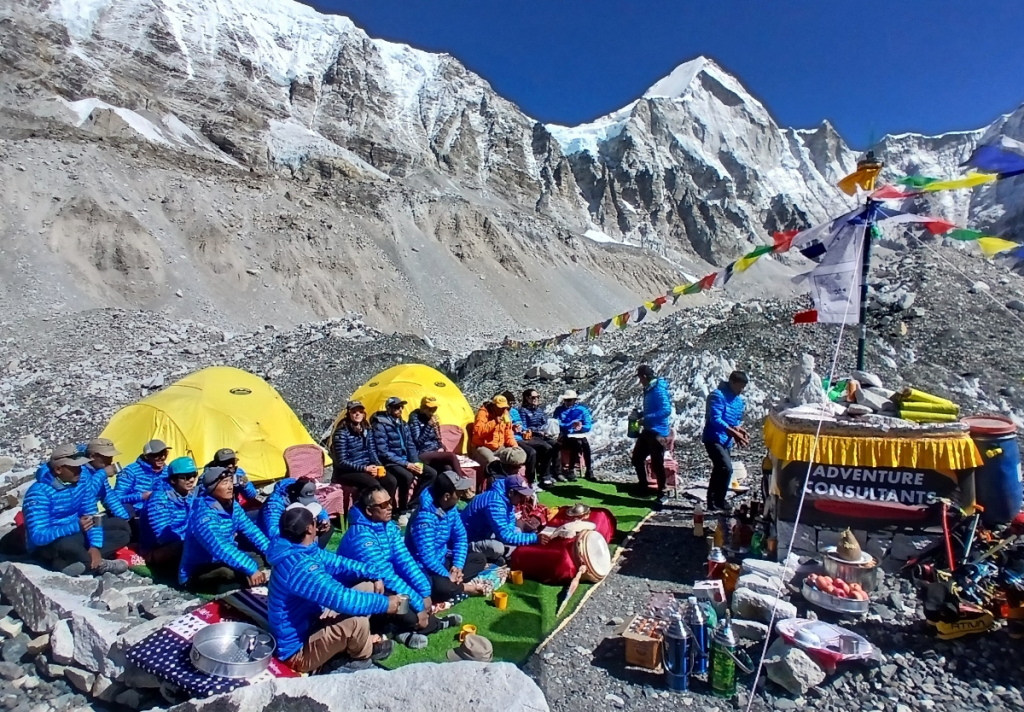
Sagarmatha, as it is known in Nepal, is not merely a mountain. It is a sacred presence, a deity in the landscape of Sherpa cosmology. The garbage that climbers leave behind is experienced not just as physical waste but as a spiritual affront. Many Sherpas perform religious ceremonies before and after expeditions precisely to honour the mountain’s sanctity. Watching it buried under abandoned tents and frozen excrement causes genuine distress.
Kanchha Sherpa, one of the last surviving members of the 1953 expedition that first summited Everest with Tenzing Norgay and Edmund Hillary, has been blunt. The mountain, he has said, is crowded and dirty. He barely recognises it.
In 2026, Bulgarian climber Angelina Angelova filmed footage at Camp 4 that spread rapidly online, showing piles of abandoned gear and shredded tents images that prompted fresh public outrage and comparisons to a landfill. For many viewers, the footage was shocking. For those who work on the mountain regularly, it was Tuesday.
The Tension at the Heart of It All
Nepal earns millions of dollars in permit fees and tourism revenue from Everest each year. For a country where many communities in the Khumbu region depend heavily on climbing and trekking for their livelihoods, the economic stakes are enormous. Restricting access or imposing heavy new costs on expeditions is not a simple decision it affects real families, real incomes, and real futures.
That tension runs through every debate about Everest’s future. Expedition leaders point out that Base Camp conditions have genuinely improved through better monitoring. Not every climber litters. Many expeditions now operate under a “clean climbing” ethic, bringing all their waste back down. Survival priorities in the Death Zone are real, not an excuse.
But the overall trajectory more climbers, faster glacial melt, more exposed waste is moving in the wrong direction. Individual good intentions, without systemic change, are not enough.
What Needs to Happen
The solutions are not mysterious. Climbers, policy experts, environmental scientists, and Sherpa guides broadly agree on what is needed: stricter permit limits tied to actual carrying capacity, not revenue targets; mandatory waste-return requirements with real enforcement; meaningful financial penalties for those who abandon gear; investment in high-altitude waste retrieval technology; and a genuine cultural shift within the climbing community — one that treats leaving behind waste as an unacceptable failure, not an understandable necessity.
Beyond the logistics, there is a simpler question of respect. Everest is not an obstacle course to be consumed and discarded. It is a living mountain, a glaciated ecosystem, a cultural and spiritual landmark for millions of people and it is suffering.
The generation that first climbed Everest in 1953 left nothing behind but their footprints. In the seven decades since, we have left considerably more. The question facing the climbers, governments, and communities of 2026 is whether we will make different choices before there is no mountain worth passing on.
