
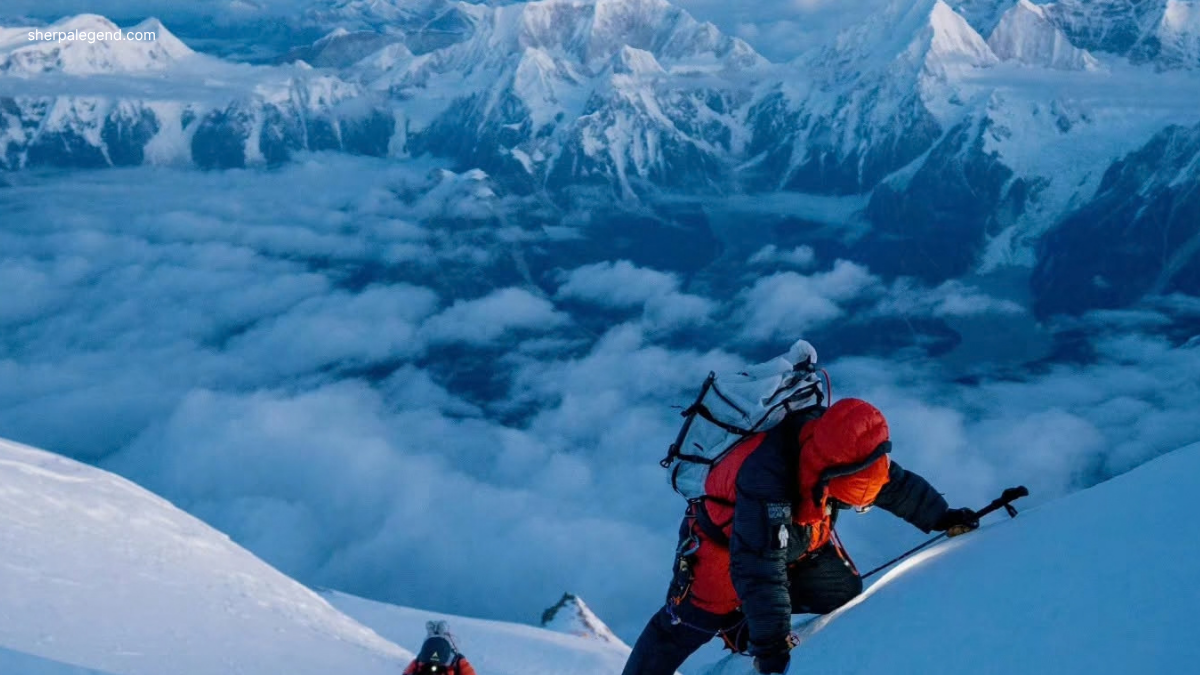

Climbers are turning around on Mount Manaslu. At Camp III, the rope-fixing team has given up trying to break trail and fix lines toward the summit. Teams are packing their gear and heading down; some climbers are already back in Kathmandu.
The season’s first weather window has closed without a single summit. Some expeditions have called off their season for good. Others are waiting at Base Camp to see how conditions hold once a disturbance building over the Bay of Bengal clears the region.
A total of 466 climbers received permits to climb Mount Manaslu (8,163m) this autumn 2026 season, according to Nepal’s Department of Tourism. Of them, 342 are men and 124 are women, spread across 39 expedition teams.
A permit is the government’s formal authorization to climb; without one, an expedition cannot legally attempt the route. Manaslu draws this many climbers every autumn because it is considered one of the more achievable of the world’s fourteen 8,000-meter peaks, which makes it a popular target for climbers chasing records, including the “14 Peaks” goal of summiting every 8,000-meter mountain.
Manaslu alone is only part of the picture: roughly 1,000 mountaineers from dozens of expeditions are on the mountain this season, and 461 of them are foreign climbers.
Seven Summit Treks has officially ended its Manaslu 2026 expedition, citing heavy snowfall, strong winds and unsafe mountain conditions.
That means the company is bringing its clients, Sherpa guides and logistics staff back down. In a statement, the company said the decision came after carefully reviewing the weather: climbers and teams had put in years of preparation and financial cost, but “no summit is more important than the lives and well-being of our climbers and team.” As the company put it, the mountain will always be there — what matters most is that everyone returns home safely.
Elite Expedition’s members are in a similar position. After successfully completing their camp rotations, they returned to Base Camp and were preparing and waiting for the right weather window to attempt the summit. That window has not come. Its members have now headed back down to Kathmandu and Samagaun to recover and wait.
The caution is not theoretical. Four climbers have already died on Manaslu this season. Two of them — a German climber and his Nepali high-altitude guide — were killed on Sunday in an avalanche near Camp III.
Shaunna Burke, who was also eyeing a Manaslu summit as part of her pursuit of the 14 Peaks, walked away over avalanche risk. “The avalanche risk wasn’t acceptable, so for me, that’s it,” she said. “It wasn’t an easy decision, but I’ve realised I don’t want the summit to define the experience. The summit is a moment; the process is everything that leads you there. I wanted to be fully present for that, and I think I was.”
On an 8,000-meter peak, weather decides almost everything. At extreme altitude, climbers depend on a “weather window” — a short stretch of calm, low-wind days that opens a brief chance to move safely to the summit and back.
Outside that window, fresh snowfall can bury the fixed ropes that climbers rely on to move through the most exposed sections, strong wind can knock climbers off narrow ridges, and new snow sitting on already unstable slopes sharply raises the risk of avalanche. That is why “waiting for weather” is not caution for its own sake. It is the one variable climbers cannot control or negotiate around.
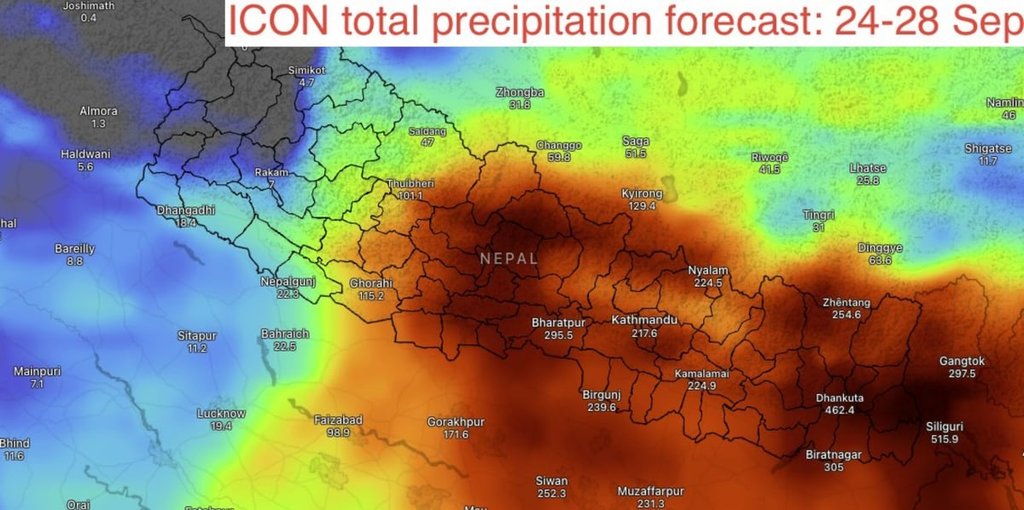
What is approaching now is a depression forming over the Bay of Bengal, already named Arnab in case it strengthens into a cyclone. Forecasters expect it could bring 400 to 600 millimeters of rain over four days, from 23 to 27 September, across parts of Nepal — compared with an annual average of roughly 500 millimeters for the region. In other words, several days’ worth of a whole year’s rain could fall in less than a week.
The danger cuts two ways. High in the mountains, the system threatens more snow, wind and avalanche risk on peaks including Manaslu and Dhaulagiri. Down in the valleys, it threatens renewed flooding in the Bhote Kosi-Trisuli valley, which is still full of loose sediment from last month’s ice-rock collapse on Langtang Lirung.
Binod Pokharel of the Central Department of Hydrology and Meteorology at Tribhuvan University, who has been tracking the depression, says it is still difficult to predict exactly which way the system’s main force will go. “The weather models differ in intensity and location of the heaviest rain, but one thing is sure: it will cover the whole of Nepal starting Thursday with thunderstorms and heavy rainfall in some parts,” he says.
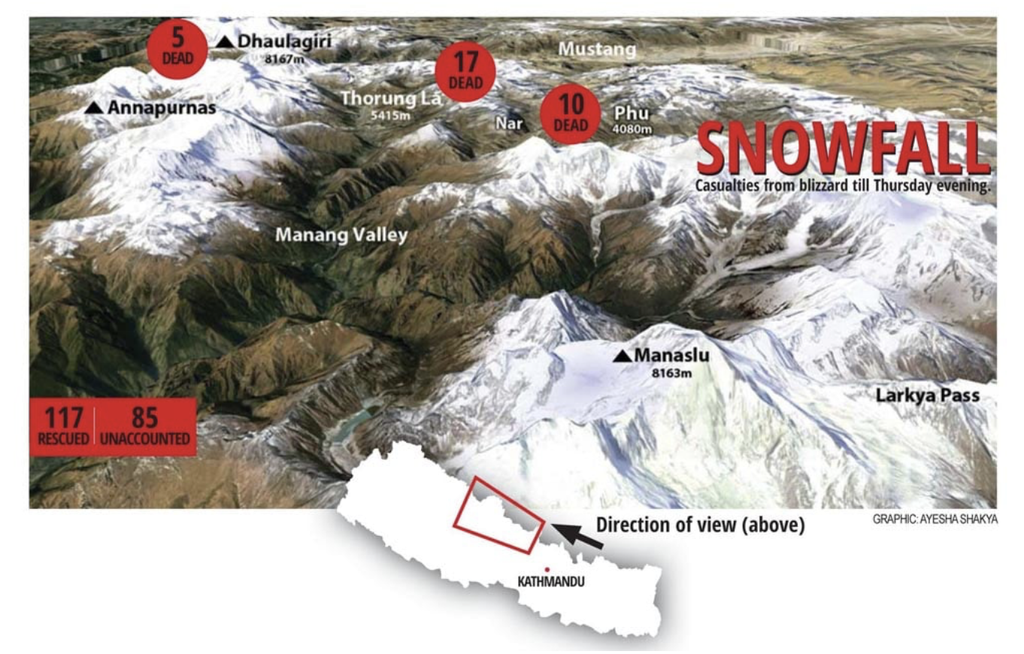
Nepal’s Department of Hydrology and Meteorology forecasts Gandaki and Lumbini provinces will see heavy to very heavy rain with thunder and lightning from Friday, 25 September, to Sunday, 27 September, with torrential rain possible in one or two areas.
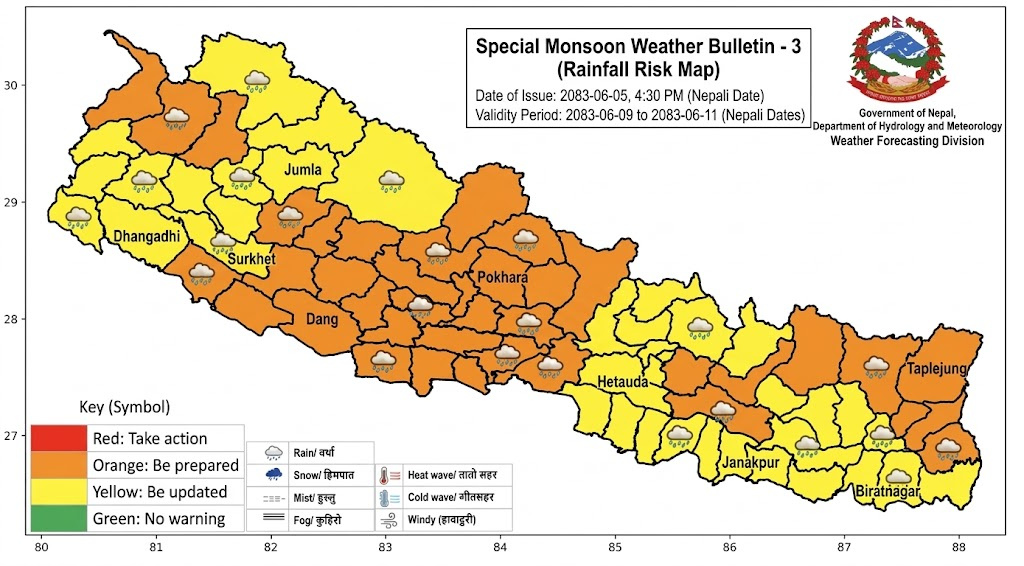
Climbers and officials are being this careful because Nepal has been through this before. In 2014, a blizzard in the Annapurna region killed 39 people, a toll worsened by a lack of early warning.
In 2005, an avalanche on Kang Guru in Manang killed 18 Nepali and French climbers. Just last September, a similar system out of the Bay of Bengal brought 600 millimeters of rain in 24 hours to an area south of Kathmandu, and the resulting flood killed 100 people and destroyed ready-to-harvest crops and riverside settlements.
Last year, a comparable late-September cyclone from the Bay of Bengal weakened before it reached Nepal, and many are hoping for a repeat this year.
Scientists with the World Weather Attribution consortium link both the Langtang collapse and these intensifying post-monsoon storms to climate change. That connection is a big part of why “wait and see” is being treated as the responsible call this season, not overcaution.
On Dhaulagiri, Lakpa Sherpa, known as Makalu Lakpa, who leads the mountain’s rope-fixing team, has suspended climbing until at least September 29, moving equipment, oxygen cylinders and supplies to lower ground while the storm passes. Meteorologist Archana Shrestha offers a note of caution of her own: named cyclones sometimes fizzle out over Nepal, she says, while the depressions and weaker systems that draw less attention have, in the past, caused the most widespread destruction.
As Seven Summit Treks put it in closing its own season: “Every successful expedition begins and ends with one responsibility: bringing everyone home safely.”
