
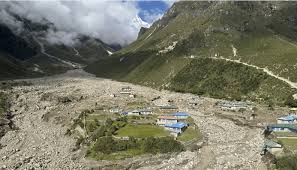

Thame is a Sherpa village located in the Khumbu Valley of the Everest region in Nepal. Situated at an altitude of around 3,800 meters (12,470 feet).
An unusual flooding in the Everest region that swept a village downstream. The flooded Thame river brought down Himalayan slopes mud, gravel and boulders, destroying 20 houses, an elementary school, and a clinic in ward 5 of Khumbu Pasang Lhamu Rural Municipality. As many as 135 people have been displaced as the Thame riverside settlement has been carpeted by mud and stones.
Defence Minister Manbir Rai on Saturday reached the affected area with a team comprising senior government officials, security officers, and experts. After inspecting the flood-hit areas and the upstream region on a helicopter flight, they concluded that a glacier lake outburst had caused the flood.
There are five glaciers and dozens of small ponds in the Thasilapcha area. Authorities have instructed the flood technical team to stay alert, as there is a risk of more ice dams bursting due to the large flow from two major ice dams, as well as the collapse of small ponds and frozen snow.
This is not the first time , In 1985, there was also a bursting of the Digcho Lake near this region, which, according to a scientific study published in 1987 by Bhuichard and Zimmerman, caused much more damage in Thame village compared to the current situation.
Several glacial lakes lie upstream of Thame. Satellite images of the area dating from 2017 show these lakes constantly changing in size, said Icimod. “Researchers there confirm that some of them frequently expand and contract, making them susceptible to breaches.”
As per Icimod’s 2023 assessment, Water, Ice, Society, and Ecosystems in the Hindu Kush Himalaya, the glaciers, snow, and permafrost are “undergoing unprecedented and largely irreversible changes over human timescales, primarily driven by climate change” and “are some of the most vulnerable to these changes in the world”.
It warns that floods and landslides are projected to increase, with climate the key driver in many of the water- and cryosphere-related disasters already recorded in recent years. This includes meltwater, larger and more potentially dangerous lakes, unstable slopes from thawing permafrost and increasing sediment loads in rivers.
The retreat of mountain glaciers has increased the size and number of glacial lakes. A threefold increase in glacial lake outburst flood risk across the HKH is projected by the end of the twenty-first century, according to the statement.
According to Icimod, as many as 47 glacial lakes among over 25,000 in the Hindu Kush Himalaya region are potentially dangerous. They lie within the Koshi, Gandaki, and Karnali river basins of Nepal, the Tibet Autonomous Region of China, and India.
The Thame flood serves as a call to action for policymakers and the international community to address the unique vulnerabilities of Himalayan ecosystems and the communities that depend on them.
