

sherpalegend.com
The opening of the climbing route through the Khumbu Icefall is more than a technical milestone on Mount Everest. It is the signal that the spring expedition season has truly begun. It allows climbers to move from Base Camp toward Camp I and Camp II, begin acclimatization rotations, stock higher camps, and prepare for the narrow weather windows of May when summit attempts become possible. However the signal came unusually late this year.
After weeks of uncertainty, Sherpa climbers known as Icefall Doctors finally opened the route through the Khumbu Icefall to Camp I on April 28, 2026, after a massive serac blocked the normal passage above Base Camp. Reuters reported that the obstacle was a roughly 100-foot ice tower, and that the delay had left hundreds of mountaineers waiting at Base Camp while teams searched for a safe passage.
This is not a small delay. In the language of Everest expeditions, it is a major compression of the season.
Why the Khumbu Icefall Opening Matters
For climbers on Everest’s south side, the Khumbu Icefall is the gateway to the mountain. It is also one of the most dangerous sections of the entire route: a moving glacier of crevasses, unstable ice towers, ladders, and avalanche exposure between Base Camp and Camp I.
Every spring, Icefall Doctors establish and maintain the route with fixed ropes, ladders, ice screws, and anchors. Their work allows commercial teams, independent climbers, Sherpa guides, load carriers, and support staff to move upward.
A late opening affects almost every part of the expedition calendar:
- Acclimatization rotations are delayed.
- Camp I and Camp II logistics are delayed.
- Load carrying becomes more compressed.
- Sherpa guides face heavier pressure in fewer days.
- Summit attempts may be pushed into a narrower weather window.
- More teams may converge on the same few good-weather days.
2026 serac has raised avalanche concerns between Base Camp and Camp I, forcing climbers and guides to wait. Icefall Doctors normally set up the route by mid-April.
Route Pattern Since-2006 : Why 2026 Looks Unusual
It’s been hard to find exact route opening dates however expedition dispatches, operator blogs, SPCC-related updates, and mountaineering coverage show that climbers first entered the Icefall or when ropes reached Camp I or Camp II, rather than publishing one standardized official “opening date.”
Still, the available record shows a clear pattern: in most modern commercial seasons, acclimatization rotations are done mid April.
Selected Route-Opening and Access Indicators Since 2006
| Year | Available public indicator | What it suggests |
|---|---|---|
| 2006 | Teams were climbing the Icefall for the first time around April 17–18. (Alan Arnette) | Mid-April access |
| 2007 | Later reports from 2012 said the Camp I route had not been in so early since 2007. (Alan Arnette) | Very early/efficient access |
| 2008 | Alan Arnette entered the Khumbu Icefall on April 12. (Alan Arnette) | Early-mid April access |
| 2012 | Icefall Doctors had fixed ropes and ladders all the way to Camp I by April 4. (Alan Arnette) | Exceptionally early |
| 2014 | The season was disrupted by the April 18 avalanche that killed 16 Sherpa guides in the Khumbu Icefall. (AP News) | Route tragedy halted normal progress |
| 2015 | The season was effectively called off after the Nepal earthquake and Everest Base Camp avalanche. (Kathmandu Post) | Season cancelled |
| 2016 | The Icefall was officially opened on April 11. (Alan Arnette) | Normal/early opening |
| 2019 | Climbers were already moving through the Icefall to Camp I by mid-April; the bigger issue came later with congestion during the summit window. (Alan Arnette) | Normal route timing, dangerous summit compression |
| 2020 | Everest’s commercial season was shut down because of COVID-19. (National Geographic) | No normal season |
| 2021 | Ropes had been fixed through the Icefall to Camp I by March 31, and climbers were entering the Icefall by mid-April. (Alan Arnette) | Early access |
| 2022 | Alan Arnette noted that in most years the route is set to Camp II by early April and to the summit by early May. (Alan Arnette) | Historical benchmark |
| 2025 | The route to Camp I was established by April 13, and The Himalayan Times later reported that 2026 opened eight days later than the April 17, 2025 clearance. (Alan Arnette) | Mid-April opening |
| 2026 | Route opened to Camp I on April 28 after a serac-related delay. (Reuters) | Unusually late |
April 28 is late by modern Everest standards.
The available data since 2006 shows that teams usually expect Icefall access by early or mid-April. A route opening at the end of April pushes climbers into May before many have properly completed rotations above Base Camp.
The Real Danger: Compression, Not Delay Alone
A delayed route does not automatically cancel an Everest season. The mountain has recovered from slow starts before. But the danger comes when too many climbers, guides, and support teams try to recover lost time at once.
Everest has a strict natural calendar. The spring season depends on the short period before the monsoon when the jet stream shifts away from the summit, reducing winds enough for climbers to attempt the top. That window usually appears in May, but it is never guaranteed.
If climbers lose two weeks in April, they do not gain two extra weeks in June. The monsoon does not negotiate with expedition schedules.
The result is pressure.
Pressure on expedition operators to move clients higher.
Pressure on Sherpa teams to stock camps faster.
Pressure on rope-fixing teams above Camp II.
Pressure on weather forecasters to identify a safe window.
Pressure on climbers who have spent years training and tens of thousands of dollars to be there.
This is where judgment becomes more important than ambition.
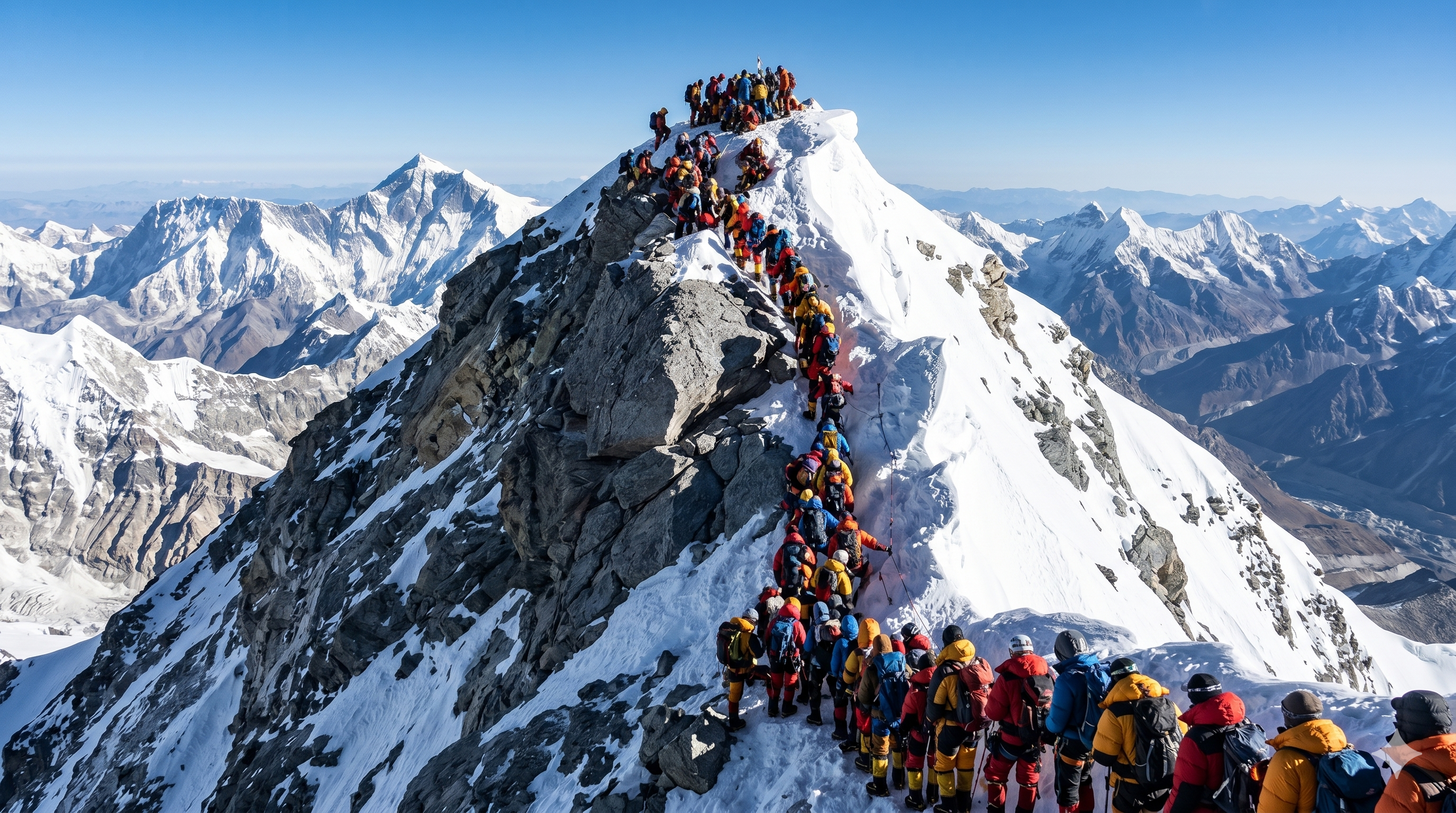
In 2019, Everest showed what can happen when weather windows, crowding, and summit pressure collide. Alan Arnette’s season summary noted that after ropes reached the summit, hundreds of people moved during limited windows; he estimated that close to 800 people were making summit bids when the next window appeared.
May 2026 Weather: The Deciding Factor
The weather in May will now play the central role in Everest 2026.
As per the mountain forecast, it shows unsettled conditions in the early May period, with cloud cover, showers, occasional snow or rain mix, and temperatures around the lower mountain ranging from roughly -4°C to 10°C between April 30 and May 9.
At summit altitude, the picture is more severe. Mountain-Forecast’s 8,850-meter forecast reported extreme cold, with temperatures around -24°C to -31°C, moderate snow, and winds decreasing after strong WSW winds in the short-range forecast. This matters because Everest summit success is not only about snow. It is about wind.
In May, climbers wait for the jet stream to shift north, creating short periods of lower summit winds. Many operators consider summit winds below roughly 30–40 km/h more manageable, although real decisions depend on full professional forecasts, temperature, snow loading, team strength, oxygen logistics, and descent conditions.
Three Possible Scenarios for Everest 2026
1. The Recovery Scenario
In the best-case scenario, the weather stabilizes in mid-May, the route to Camp II and above is efficiently prepared, climbers complete essential rotations, and teams spread their summit pushes across multiple windows. This would allow the season to recover despite the late opening.
2. The Compressed Summit Scenario
In a more concerning scenario, only one or two clear windows emerge. Teams that have lost time may converge on the same dates, producing crowding in the Icefall, the Lhotse Face, Camp IV, the Balcony, the South Summit, and the Hillary Step area.
This is where delays become dangerous. The risk is not only on the way up. It is on the descent, when fatigue, oxygen management, frostbite, traffic, and changing weather become critical.
3. The Monsoon Pressure Scenario
In the worst-case scenario, the May window remains unstable and teams wait deeper into the month. A late summit push closer to the monsoon increases the chance of fresh snow, avalanche hazard, cloud buildup, poor visibility, and difficult helicopter/rescue operations. Everest does not become safer just because climbers have waited longer.
Note: “Exact public route-opening dates are not consistently available for every year since 2006. However, recent verified records show that the Icefall route normally opens around mid-April, while the 2026 opening on April 28 was unusually late.”
Sources: Reuters, Associated Press, The Kathmandu Post, The Himalayan Times, Outside, Alan Arnette, Sagarmatha Pollution Control Committee.
